|
 |
|
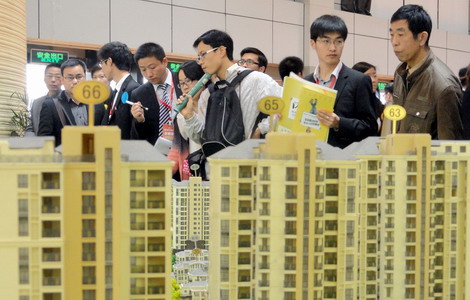
People look at a model of housing project during a real estate exhibition in Suzhou, Jiangsu province. Experts say the overall investment rate is likely to drop further because of the bearish property market and depressed manufacturing sector. [Photo / China Daily] |
Investment growth in the first four months was at its lowest level in nearly a decade due to the cooling property market and slowing manufacturing activity, but the figure may rebound in the second quarter as a result of policy incentives, experts said.
Fixed-asset investment increased 20.2 percent year-on-year to 7.56 trillion yuan ($1.2 trillion) in April, while the growth rate was 0.7 percentage points lower than that in the first three months, according to a statement on the website of the National Bureau of Statistics on Friday.
The investment growth registered its lowest level since December 2002, but analysts said the situation was not yet a cause for concern as the slowdown was "within expectations".
"The decrease in investment growth was partly because of the impact from global economic downturn, but more a result of regulations," said Tang Jianwei, a macroeconomics analyst with the Bank of Communications, who estimated that investment in the first four months would grow 20.3 percent year-on-year.
The industrial output of companies with annual revenue of more than 20 million yuan, which increased 9.3 percent year-on-year in April, was also growing at its slowest pace since mid-2009, according to the NBS.
"Manufacturers are seeing slower growth in investment because of a continuous weakening of exports amid sluggish global demand, and that was out of our control," Tang said.
But investment growth in the property market, which fell for the eighth consecutive month, was a projected result of the government's regulatory efforts, he said, adding that growth will continue to decelerate as the curbs will remain.
The value of homes sold in April declined to 315.4 billion yuan from 373.3 billion yuan in March and 324.9 billion yuan a year earlier, according to the NBS.
Wang Han, an analyst with Industrial Bank Co, said the overall investment rate is likely to drop further because of the bearish property market and depressed manufacturing sector, which account for more than 50 percent of total investment.
"To that end, GDP growth may plunge below 8 percent in the second quarter, but we won't panic, as long as the government doesn't," Wang said.
Investment will continue to serve as a main driver of the Chinese economy, Tang said. But "only with a slower and more rational investment growth can the country achieve a successful economic transformation", Tang said.
Meanwhile, investment may rebound in the second quarter of the year, according to Tang.
"The authorities have restarted approval of new construction projects ... and more incentives will be released," he said.
"The policies will not be on a similar scale to the massive stimulus seen in 2008, but will be more targeted and fine-tuned," he said.
Tang expected year-round investment growth to be around 21 percent, even though the figure may fall below 20 percent for at least one or two months.
Tang's estimate was echoed by Wang Tao, chief economist with UBS AG, who said investment in infrastructure and affordable-housing projects will drive up growth in the next few months.
"More incentive policies will be released to support investment in infrastructure, energy, environment and services, which will offset the slowdown in property and manufacturing," Wang said in a research report.
Wang said real growth in fixed-asset investment may even exceed last year's figure of 23.8 percent due to relaxed monetary and fiscal policies, though the nominal figure will still be around 20 percent as prices fall.
However, increasing fiscal incentives will not be easy, as fiscal revenue growth has declined due to the slowing economy.
Total fiscal income in April grew only 6.9 percent year-on-year to 1.08 trillion yuan, according to a statement from the Ministry of Finance on Friday. The growth was down from 18.7 percent in March and an average of 25 percent last year.
The slowing growth was mainly a result of reductions in the amounts collected from personal income tax and corporate income tax, due to tax cuts and shrinking business revenues.
Meanwhile, lower tax incomes were also seen from vehicle purchases and stamp duty, due to sliding automobile sales and a declining trading volume in the stock market.
Fiscal expenditure was also growing at a slower pace in April, at 8 percent year-on-year, down from 34.7 percent in March.
A reduction of 14.9 percent in central government spending was the main cause of the decrease, while spending by local governments rose 14.8 percent, according the Finance Ministry's statement.
"Local government will be the main force in fiscal expenditure, though they face the challenge of declining revenues," Tang said.
weitian@chinadaily.com.cn

Copyright 1995 - . All rights reserved. The content (including but not limited to text, photo, multimedia information, etc) published in this site belongs to China Daily Information Co (CDIC). Without written authorization from CDIC, such content shall not be republished or used in any form. Note: Browsers with 1024*768 or higher resolution are suggested for this site.
License for publishing multimedia online 0108263 Registration Number: 130349