Continuously weak demand from developed economies has already led some experts to forecast that China may miss its 2012 foreign trade growth target.
But a slowdown may not be an entirely bad thing, they said, because it could spur more companies to undergo technological upgrading and come up with better products and services.
Anbound, a Beijing-based consultancy, said it is highly unlikely that China's foreign trade can grow by the 10 percent that was anticipated earlier this year.
This comment was made prior to the publication of China's April trade data on Thursday, which saw exports grow 4.9 percent year-on-year, reaching $163.25 billion, while imports grew just 0.3 percent, to $144.83 billion.
Both figures are a far cry from the 10 percent mark set for the year.
Although coastal provinces and municipalities are working hard to regain their glory as the nation's champion exporters, their adjustment is obviously painful and taking more time to show results.
In the first quarter of the year, China's export growth was 7.6 percent year-on-year, reaching $430.02 billion, and import growth was 6.9 percent, hitting $429.35 billion.
In April, China's trade with its traditional main partners - the European Union, the United States and Japan - fell to single-digit year-on-year growth, while one year ago, China's trade with all three partners grew by more than 15 percent.
According to Qu Hongbin, HSBC chief economist for China, the eurozone is definitely in the "second dip" of its crisis, and this will have a serious impact on China's export growth.
In the first four months of the year, China-EU trade grew by just 0.3 percent year-on-year.
But, according to Hu Yanni, an analyst with China Securities Co, Europe is not the only cause for concern.
The prolonged sluggish state of the global economy as a whole would put a damper on China's foreign trade.
April's trade data, which showed even less growth than the difficult first three months, may have dashed the hopes of those economists who had forecast that China would recover relatively easily to double-digit trade growth.
In early April, in a survey of 26 research bodies and economists by Caijing.com.cn, a financial information website, most respondents said China's overseas trade would do better in April than in March. In reality, however, the hoped-for improvement did not materialize.
Other economists argued that apart from a few bright spots such as Russia, Brazil and India, China's exporters would have few chances to maintain their business growth unless they become more innovative.
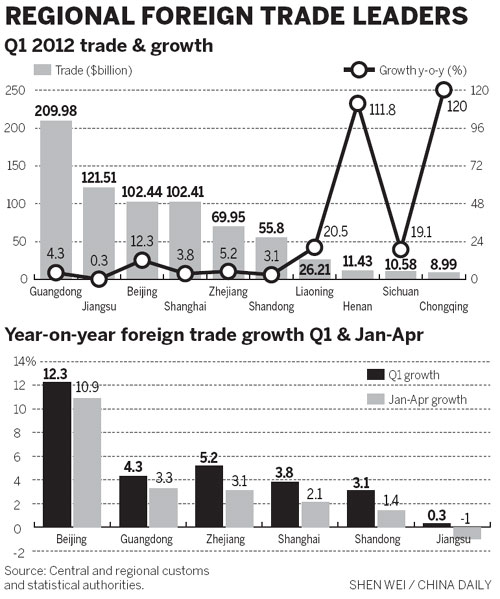
In the first four months, around a dozen provinces saw their export growth fall to single-digit figures, including the traditional trading powerhouses of Guangdong, Shanghai, Zhejiang and Shandong.
Coastal Jiangsu province even registered a 1 percent decline.
In Guangdong, the largest exporting province, while its GDP growth slowed to 7.2 percent year-on-year, foreign trade growth trailed far behind at just 3.3 percent.
"But a fall in the growth rate may not necessarily be a bad thing," said Ding Li, a researcher with the Guangdong Academy of Social Sciences.
Maybe, he said, this will be the only way to get companies to seek technological upgrading and new ways of development.
Guangdong leaders' intentions are quite obvious from Nanfang Daily, the province's Party newspaper.
The newspaper is trying to encourage the entire province to emulate Foshan, a manufacturing city in the Pearl River Delta which is famous for making 100 microwave ovens a minute, more than 200 washing machines an hour, over 20,000 refrigerators a day, and 23 million home air conditioners every year.
Foshan's foreign trade volume increased from $11 billion in 2001, when China joined the World Trade Organization, to $50 billion last year. Local companies have no interesting in chasing growth by volume any longer, Nanfang Daily reported.
Instead, they are turning to technology-based, high value-added growth - by clinching large orders from large buyers. The strategy seems to have given the city a competitive edge, as its exports of electrical appliances continued to rise in the first quarter.
The dilemma faced by Guangdong's exporters is the same one that confronts their counterparts across the country.
In the first four months, garment exports totaled slightly less than $40 billion, showing a year-on-year increase of only 1 percent. Textile exports fell 0.3 percent to $28.85 billion, and footwear exports increased 4.2 percent to $12.4 billion.
In contrast, exports of electronic goods and machinery totaled $346.79 billion, showing an increase of 8.5 percent. In this category, machinery exports totaled $115.05 billion, growing by 11 percent.
Contact the writers at zhengyangpeng@chinadaily.com.cn and huangying@chinadaily.com.cn

Copyright 1995 - . All rights reserved. The content (including but not limited to text, photo, multimedia information, etc) published in this site belongs to China Daily Information Co (CDIC). Without written authorization from CDIC, such content shall not be republished or used in any form. Note: Browsers with 1024*768 or higher resolution are suggested for this site.
License for publishing multimedia online 0108263 Registration Number: 130349