Comments()
  Print
Print  Mail
Mail  Large Medium Small
Several major Chinese cities have some of the world's highest per capita carbon footprints, a World Bank report said on Thursday.
Greenhouse gas emissions (measured in tons of carbon dioxide equivalent per capita) in Tianjin, Shanghai and Beijing far exceed those of cities such as Paris, Tokyo, London, Barcelona and Jakarta.
Industry and power generation are major contributors in Chinese cities, largely because coal dominates the nation's energy use.
Globally, most urban emissions come from transport, buildings and waste, but these three sectors only account for about 20 percent of China's urban emissions.
|
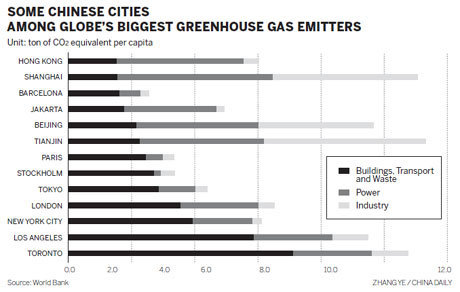 |
According to data from the three Chinese cities, about 40 percent of urban emissions are from power generation and another 40 percent from industrial activities.
Shomik Mehindratta, a World Bank urban transport specialist and co-editor of the report, said Chinese cities have high emission levels because they are important global centers of industrial production.
Cities account for more than 70 percent of energy-related greenhouse gas emissions worldwide and this is expected to rise to 76 percent by 2030, said the report.
China's urbanization is accelerating, and about 350 million people are expected to move into cities during the next 20 years.
The number of people living in China's cities for the first time exceeded those living in rural areas by the end of 2011, with an urbanization rate of 51.3 percent, the National Bureau of Statistics said earlier this year.
Axel Baeumler, World Bank senior infrastructure economist and a co-editor of the report, titled Sustainable Low-Carbon City Development in China, said Chinese policymakers face a an important question: will China follow a high- or low-emissions path as it urbanizes.
The report said that cities must act on multiple fronts to achieve low-carbon growth and also incorporate responses to climate change in planning, investment decisions and emergency-preparedness plans.
A critical issue for China's leaders to consider is the spatial growth of Chinese cities and links with municipal finance, as spatial growth patterns determine long-term carbon use in a city.
Sprawling cities are locked into a high-carbon development path.
"Local governments are relying on land transfers and land development to raise revenue for building infrastructure and urban development, but such an approach is unsustainable.
"The links between land use, finance and urban sprawl need to be broken," said Liu Zhi, lead infrastructure specialist at the World Bank's Beijing office.
The report recommends that urban leaders encourage a cleaner supply of energy, enhance market-based methods of energy demand management (including prices that reflect full costs), enforce energy-efficient building codes and switch to consumption-based billing for district heating.
It also suggests optimizing the transport system to provide alternatives to automobiles and encourage walking and bicycling.
China aims to reduce its energy intensity (a measure of how much energy is used to produce a unit of GDP) by 16 percent by 2015 - the last year of the current five-year plan - and cut its carbon dioxide emissions per unit of GDP by 17 percent in the same year.
lanlan@chinadaily.com.cn
Copyright 1995 - 2010 . All rights reserved. The content (including but not limited to text, photo, multimedia information, etc) published in this site belongs to China Daily Information Co (CDIC). Without written authorization from CDIC, such content shall not be republished or used in any form. Note: Browsers with 1024*768 or higher resolution are suggested for this site.
License for publishing multimedia online 0108263 Registration Number: 20100000002731