Household spending
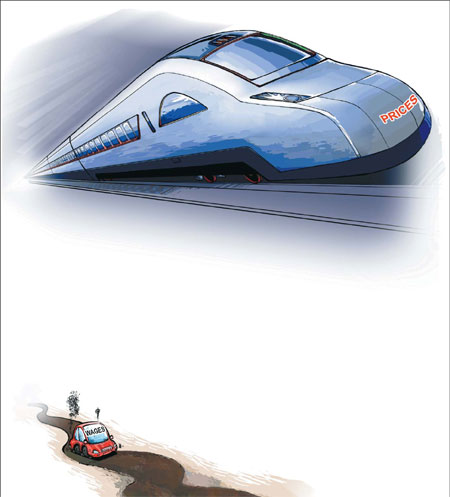
Despite China maintaining two-digit economic growth, the proportion of household income in GDP also declined in recent years. The ratio dropped from 53 percent in 1995 to 40 percent in 2007, according to Bai Chongen, associate dean of Tsinghua University's school of economics and management.
"Workers' pay is the most important source of residents' disposable income and the declining ratio of household income in GDP would affect spending," he told a recent forum.
Perhaps more significantly, the widening income gap between different groups of wage earners has also curbed overall spending.
The average income in the sectors with the highest-paid workers is about seven times higher than that of those with the least paid, said Yang Yiyong, director of the social development research institute under the National Development and Reform Commission.
In addition, official statistics show that in 2010, the average annual salary of a public sector worker was more than 37,000 yuan, while a worker in the private sector earned only 20,700 yuan.
And although the government has been increasing the minimum wage, an ILO report in 2009 found that more than 20 percent of local workers and about 40 percent of migrant workers in China were still underpaid.
Liu Junsheng, a researcher with the labor and wage institute under the Ministry of Human Resources and Social Security, said that official statistics of workers' average wages were only calculated from earnings in State-owned, overseas-funded and large private enterprises, while the income of workers in small and medium-sized enterprises (SMEs), which employ almost 70 percent of the total labor force, were not included.
The ILO recognizes these disparities, and it may be another reason why its figure for the average monthly wage differs so much from that of China's National Bureau of Statistics.
"The official figures do not reflect real wages of the majority of workers because they are not covered by the calculation, and that's why many people would feel that both their wages and purchasing power have been overestimated," Liu said.
Insecure living
Wu Fei works at a perfume design company in Beijing and earns more than 5,000 yuan a month an above-average income by either calculation.
Wu said he spends 1,100 yuan a month on renting an apartment, which he shares with two other people, about 1,500 yuan on food, and another 500 yuan on telephone, transport, and water and electricity bills.
"I can live on that income, but the disposable part, what's left to spend, is less than 2,000 yuan. I don't feel very secure with that because I wouldn't know how to deal with a sudden sickness or other emergencies with such a small sum of money," he said.
Wu said he is considering finding part-time jobs to make more money. But how much would be enough to feel secure?
An online forum has attracted calculations and suggestions recently from around the country. The site posted a list of baseline wages that would satisfy people in 2012 in different cities. In Beijing, the bottom line would be 8,550 yuan a month while in Shanghai they're looking to earn at least 9,250 yuan.
According to the statistics authorities in these cities, the average monthly salary of workers in Beijing in 2011 was 4,672 yuan and in Shanghai, 4,331 yuan.

Copyright 1995 - . All rights reserved. The content (including but not limited to text, photo, multimedia information, etc) published in this site belongs to China Daily Information Co (CDIC). Without written authorization from CDIC, such content shall not be republished or used in any form. Note: Browsers with 1024*768 or higher resolution are suggested for this site.
License for publishing multimedia online 0108263 Registration Number: 20100000002731