|
|
He said the so-called Washington Consensus that aimed to liberalize the economies of developing countries had demonstrably failed and the Chinese were now picking up the pieces.
"The official doctrine among the international financial institutions which in the past determined policy in Africa was that infrastructure would be taken care of by the private sector. Well, we have waited 30 years and nothing much has happened," he said.
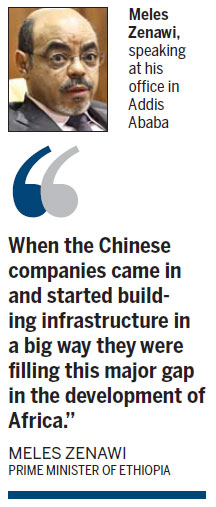
"When the Chinese companies came in and started building infrastructure in a big way they were filling this major gap in the development of Africa. We, in Africa, should feel very satisfied with it."
Zenawi, who was speaking from his expansive office complex near the center of Addis Ababa, said China's investment in Africa was transforming the economic fortunes of the continent.
"Firstly, it is the growth of China that has increased the prices of commodities, minerals and other products of Africa which had been in secular decline for decades leading to the marginalization of the African economy as a whole," said Zenawi, who has been prime minister for the past 21 years.
"Secondly, Chinese companies have come in in a big way to develop these resources that had been sitting idle for some time. And, thirdly, the Chinese have trillions of dollars of savings, a small proportion of which is being used to develop infrastructure in Africa."
Chinese investment in infrastructure in Ethiopia dates back to 1972 when it financed the Wereta-Weldiya road across the Rift valley.
Over the next three years, a Chinese state-owned company is to build the final section of a 339 km railway line linking Addis Ababa to the Red Sea state of Djibouti.
The Chinese are also funding a toll road along the same route, and leading Chinese companies are making major investments in hydro power and setting up cellular and 3G networks.
Zenawi, who lives in a city dogged by frequent power cuts and gridlocked roads, says a lack of infrastructure is one of the Africa's most serious economic challenges.
The World Bank estimates the continent as a whole has an annual infrastructure funding gap of $90 billion.
"When you have a gap that size in a key sector like infrastructure, you can imagine to what extent it affects the prospects of the development of this continent," he said.
Dominating the Addis Ababa skyline is the new gleaming $124 million African Union Headquarters, which is in marked contrast to much of the city's older rundown architecture.
It was not only built and constructed by the Chinese but donated as "China's gift to Africa".
Zenawi rejects criticism from some elements within the continent that such a high profile building should have been built using solely African resources.
"I am sure if we had done that we would have been accused of going after 'white elephants' projects. When it comes to certain quarters in Africa, you are damned if you do and you are damned if you don't," he said.
"The fact of the matter is that it was the Africans who asked the Chinese to build this conference hall for Africa. It is not the Chinese who offered to build it. We asked them to build it and they agreed and they have delivered, and we have no reason to criticize this," he said.
Zenawi made an official visit to China last August and said while touring the Pearl River Delta he was keen to encourage Chinese manufacturers to Ethiopia.
Within weeks of his visit an official Chinese delegation visited the country, and one Guangdong manufacturer, Huajian, has now set up a shoe manufacturing facility.
"I thought they would be fast, but I didn't expect them to be that fast," he said with a laugh.
Zenawi believes Ethiopia can be just as an attractive alternative manufacturing center to China as Cambodia, Thailand and Bangladesh.
China is expected to shed some 80 million manufacturing jobs over the next three to four years as a result of rising labor costs, according to the World Bank.
"I don't think it is an either or because China is as big as all these countries combined and more. So whatever labor-intensive manufacturing is shed from Africa, it should be adequate for everyone," he said.
The prime minister dismissed notions that Africa had to also overcome perceptions that its workers were not as productive as those from Asia.
"The same has been said of Asian workers at some stage, including the Japanese (in the 19th Century). History and practice have shown that these are tricks that can be learned very quickly," he said.
He said the newly arrived Guangdong manufacturer, which has sent some of its Ethiopian workers for training in China, was a case in point.
"They are extremely surprised to find the Ethiopians quite capable of doing as well as the Chinese despite the fact an industrial culture here is absent," he said.
"All it requires is commitment and belief in the capacity of Africans to do what others have done, and if they are given a fighting chance I am sure they will survive."

Copyright 1995 - . All rights reserved. The content (including but not limited to text, photo, multimedia information, etc) published in this site belongs to China Daily Information Co (CDIC). Without written authorization from CDIC, such content shall not be republished or used in any form. Note: Browsers with 1024*768 or higher resolution are suggested for this site.
License for publishing multimedia online 0108263 Registration Number: 20100000002731