|
 |
|
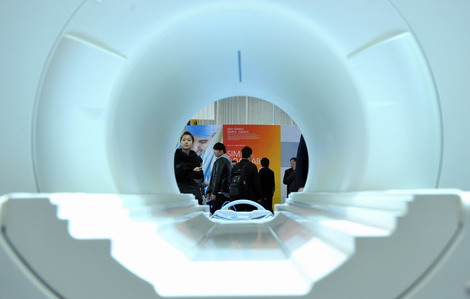
An image seen through a CT scanner at an international medical equipment exhibition in Beijing. Domestic makers are challenging foreign big names as the Chinese market expands. [Photo / China Daily] |
Two-year-old Jiang Jie, who saw his father die of disease and his mother run away from home, lives with his grandparents in Wuyapo village, a mountainous area about a three-hour drive from Chengdu.
The boy is thinner and shorter than other kids of his age and had complained of feeling weak. However, his grandparents were too old and too poor to take him to a hospital in Chengdu, the capital city of Southwest China's Sichuan province.
Luckily, Jiang Jie was examined by a team of doctors who came to his village with high-tech, smartphone-like devices. They diagnosed him as having congenital heart disease.
"The boy can be as healthy as ordinary boys after an operation; otherwise, he may continue to be very weak and die at a young age," said Hu Dayi, the leader of the team and director of the cardiovascular disease department at Peking University People's Hospital.
"Early diagnosis enables patients to get early treatment and may even save their lives," Hu said. "These small, portable, multi-functional devices allow us to better serve remote areas."
The device which may have saved Jiang Jie's life is called Vscan. Priced at $7,999, it was introduced to China last May by GE Healthcare, a medical arm of General Electric Co. It provides ultrasound imaging, measurement and analysis of the human body and clinical detection of various diseases.
"It is like a small mobile scanning room. The compact size, high degree of portability, and simplified user interface make our work easier and more efficient," said Hu.
Vast rural market
In recent years, GE Healthcare has introduced a series of small, portable, and relatively inexpensive devices to China. It is aiming at the nation's vast grassroots market, including hospitals in small and medium-sized cities and counties, as well as clinics in rural areas and urban residential communities.
The US-based medical equipment provider is not alone in China: A group of multinational medical device companies, including Siemens Healthcare, Philips Healthcare, and Toshiba Medical System Co, are developing products tailored to China's grassroots market.
Last June, Philips Healthcare, a subsidiary of Royal Philips Electronics Ltd, set up its second Chinese regional headquarters in Chengdu to facilitate a planned expansion in western China.
In October, Siemens Healthcare, the medical arm of Siemens AG, established a research institute, intended to develop high-quality, low-cost imaging equipment to serve China's grassroots communities.
"They are looking at huge market potential here, which is being stimulated by China's new medical reform policies," said Hu Jin, an analyst with Huatai Securities Co Ltd.
In mid-March, the Chinese government issued new medical reform policies, which make infrastructure construction and equipment upgrades at grassroots medical institutions among its top priorities for healthcare in the 2011-2015 period.
According to Guo Fanli, an analyst with China Investment Consulting Co Ltd, medical institutions in China's rural areas account for only 7 percent of the nation's total, while providing service to about 60 percent of China's 1.3 billion people.
"The central government is determined to fundamentally improve grassroots health care services. In 2009, investment in rural medical infrastructure amounted to 2.7 billion yuan ($429 million)," said Guo. He predicted that government funding of this sector will reach dozens of billion yuan by 2015.
Medical equipment sales in China amounted to 135 billion yuan in 2011, about 26.6 percent more than the previous year, according to a report by China Economic Information Network, a domestic information service provider affiliated with the State Information Center. The report predicted that the market will grow rapidly in the next five to 10 years, with a compound annual growth rate of 20 to 30 percent.
Rachel Duan, China president and CEO of GE Healthcare, told China Daily that sales to China's grassroots market will increase to half of the company's business in China within five years, from less than 20 percent at present.
"We will launch 32 new products here over the next three to four years, 70 percent of them tailored to grassroots medical care institutions," she said. "Seven will be launched this year and another 25 are expected in the coming two to three years."
Bernd Montag, CEO of the Imaging and IT Division of Siemens Healthcare, said one of the company's top priorities in the coming years is IT solution development, intended to "cover more patients at less cost". Mobile and wireless technologies, coupled with the Internet, make long-distance diagnosis and data sharing possible. Using portable devices, healthcare personnel can do on-site examinations in inaccessible locations and get professional diagnosis and therapy suggestions from large medical centers, greatly improving grassroots medical services, he said.


Copyright 1995 - . All rights reserved. The content (including but not limited to text, photo, multimedia information, etc) published in this site belongs to China Daily Information Co (CDIC). Without written authorization from CDIC, such content shall not be republished or used in any form. Note: Browsers with 1024*768 or higher resolution are suggested for this site.
License for publishing multimedia online 0108263 Registration Number: 130349