 |
|
|
 |
|
|
|||||||||
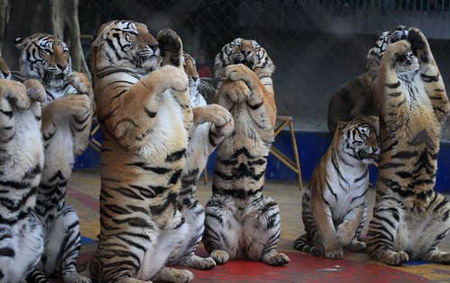 Tigers trained to greet visitors at a show in Nanning, South China's Guangxi Zhuang autonomous region. Animal rights activists have called for a ban of all animal performances. [Photo/China Daily]? |
Animal rights groups are calling for a ban on all animal performances in China, including live shows, petting zoos and photo sessions.
However, their campaign - which also calls for a ban on dolphin shows - is said by some to have gone too far.
Animal performances and circus shows, especially in Beijing, have "seriously impaired the country's and city's image with brutality and savage behavior", Liu Huili, an animal rights supporter and researcher with Green Beagle, a Beijing-based non-governmental organization, said at a symposium on Saturday.
Attendees at the symposium, including researchers and volunteers from Green Beagle, China Zoo Watch and the Beijing Loving Animals Foundation, proposed the performance ban, especially in the capital city.
China Zoo Watch conducted a study from January 2011 to the end of March, in which it sampled more than 40 zoos nationwide. It found that animal performances, which it claims often involve acts of cruelty, are common nationwide.
About 50 percent of urban zoos, 91 percent of animal parks and 89 percent of aquariums offer such performances, according to the survey.
Performances include animal wire walking, jumping through fire loops, standing upside down and boxing, which "might seriously impair the animals' physical and psychological health", Liu said.
In Beijing, the wildlife park in Daxing district offers shows of dogs jumping through fire loops, and another wildlife park near the Badaling section of the Great Wall features wolves and tigers jumping across fiery circles and bears playing with flaming sticks, the survey found.
Both parks declined to comment on the issue when reached by China Daily on Sunday.
Liu Nonglin, a senior engineer of the Chinese Association of Zoological Gardens, said a zoo should be a demonstration site for animal protection.
Liu said people could also be hurt by many zoo animals or catch diseases. However, he said, a total ban on animal performances would take time and require public cooperation and a change in attitudes.
The Ministry of Housing and Urban-Rural Development issued a circular in 2010 banning animal performances nationwide, but the rule does not apply to aquariums.
However, as the circular didn't specify penalties, animal performances and petting zoos featuring wild animals remain a common practice, said Sun Xiaochun, a ministry official.
"It (the circular) is more of a warning than a regulation," she said, adding that the ministry might revise the rules to impose tougher punishments.
But not everyone agrees with the campaign against animal performances.
Zhou Haipeng, 22, a student at Beijing Foreign Studies University, said he found animal performances, especially by dolphins, very loving and informative, rather than cruel and merciless as depicted by the activists.
He said he first went to the Beijing Aquarium in 2008, when he arrived in the capital for study, and was very impressed.
"The dolphin show was cute," said the student from South China's Guangxi Zhuang autonomous region. "That was the first time I saw a dolphin in the flesh."
Zhou said it would be sad if animal performances are banned, especially the dolphin shows.
"People, especially those from inland cities, could see and touch animals and become further aware of how to protect them, which is a good thing," he said. "Jumping a fire loop is too dangerous, but dolphins swimming in the water is not."
The Beijing Aquarium told China Daily on Sunday that their dolphin training is animal friendly, not based on punishments.
"It is not against the animals' will as those NGOs said, and there is definitely no animal abuse," said a spokeswoman of the aquarium, speaking on condition of anonymity.
"We offer animal performances to let the public know how cute they are and how to better protect our (animal) friends."
There are 24 dolphins at the Beijing Aquarium, all of which appear in the shows, 15 minutes each and two or three a day, according to their physical condition.
The Beijing Aquarium stopped allowing people to interact with the dolphins, which included allowing children to kiss the animals, in 2010.
"There're no more performances we can call off. All we have left are some simple performances, like jumping and bouncing balls," the spokeswoman said.
"We're keeping records of the dolphins' physical and psychological condition, while providing sufficient nutritious food.
"All the dolphins have been healthy since the aquarium was established 12 years ago," she added.
zhengxin@chinadaily.com.cn