|
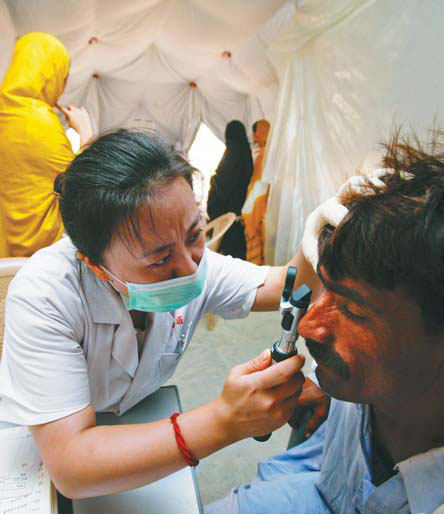
A Chinese ophthalmologist examining a patient in Thatta, Pakistan, in 2010, when the region suffered devastating floods. Zhou Lei / Xinhua |
China, along with other BRICS countries, has significantly increased health aid programs to less-developed nations since 2005, according to a report by Global Health Strategies Initiatives on the eve of the summit in New Delhi.
GHSI is an international nonprofit organization working to improve health in developing countries.
The report, based on an analysis of the BRICS' global health and development efforts, indicates that although G7 donors - United States, Japan, Germany, France, United Kingdom, Italy and Canada - still provide far more assistance, the average annual growth rate of BRICS' foreign aid spending was much higher between 2005 and 2010.
China has been a leader on malaria treatment in Africa, India is currently the largest producer of low-cost drugs and vaccines, and South Africa is pioneering new molecular diagnostics for tuberculosis, the report stated.
Generally, public and private sector innovators in the BRICS countries were producing high-quality, low-cost health technologies that have greatly helped poor populations access health facilities.
He Shuangrong, a professor at the Institute of Latin American Studies at the Chinese Academy of Social Sciences, said that, compared with the financial assistance provided by developed countries, the aid from BRICS focused more on regional development and imposed no political conditions on the least-developed countries.
"As emerging powers, BRICS are gradually taking the responsibility to help the less-resourced countries. It is a route any emerging power has to go along to get recognition from international society," she said.
At the same time, BRICS are investing heavily in health research and technology to support aid efforts, the report said. For instance, China has pledged to increase research and development expenditure on health programs from 1.3 percent of GDP in 2005 to 2.5 percent by 2020, and the government is working with vaccine manufacturers to increase production for global markets.
"The BRICS are contributing significant new resources to global health and development efforts. Just as importantly, they are establishing new models for cooperation that challenge the way we think about foreign assistance," said David Gold, one of GHSI's founders.
The GHSI report shows that BRICS approach foreign assistance differently to traditional donors. In healthcare and other areas, the BRICS emphasize South-South cooperation and technical support.
At a meeting in 2011, the BRICS ministers of health declared their commitment to work collectively on health and to support health efforts in other developing countries.
"With growing capacity for innovation and an emphasis on South-South partnership, the BRICS are delivering important new health interventions and technologies to developing countries," Gold said.
Rani Mullen, a visiting fellow at the Center for Policy Research, based in New Delhi, commented: "The BRICS countries are already cooperating in areas such as health, agriculture, science and technology.
"As these collaborations continue to expand and deepen, they could have a significant impact on health and potentially transform the way countries work together to improve health in the developing world."
As assistance spending increases, China recently issued a white paper outlining its approach to foreign assistance, while Brazil, Russia, India and South Africa all have national aid agencies in operation.
He, from the Chinese Academy of Social Sciences, said although BRICS are developing countries, they can increase aid to the poorest countries if it proves beneficial to regional stability and development.
"The health expenditure is strategic to BRICS and regional development, and I believe it will become a long-term policy for BRICS countries," He said.
Contact the writer at wangchao@chinadaily.com.cn


Copyright 1995 - . All rights reserved. The content (including but not limited to text, photo, multimedia information, etc) published in this site belongs to China Daily Information Co (CDIC). Without written authorization from CDIC, such content shall not be republished or used in any form. Note: Browsers with 1024*768 or higher resolution are suggested for this site.
License for publishing multimedia online 0108263 Registration Number: 130349