|
|
|
 |
|
|
|||||||||
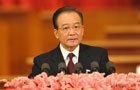
The central government has decided in its budget that government spending on education will account for 4 percent of the country's GDP this year, said Premier Wen Jiabao, when delivering the government report at the opening ceremony of the annual session of the National People's Congress on Monday.
Local budgets should also prepare to meet the target, he said.
"More resources should be allocated to central and western regions, rural and remote areas and places with concentrations of ethnic groups, to facilitate balanced development of compulsory education," he said.
In China, compulsory education consists of nine years of primary school and junior middle school education.
"It's the first time that the government put the proportion of education spending in GDP in its work report. It was not easy in the past when there was no enough money, and it's also not easy to make the spending efficient now," said Cheng Tianquan, Party chief of Renmin University of China.
There is little chance of equipping schools in all places with the same resources and facilities, but the government should make efforts to ensure that schools of the same kind possess the same facilities, said Cheng, who is also a member of the Chinese People's Political Consultative Conference National Committee.
Zhang Li, director of the National Center for Education Development Research under the Ministry of Education, said he is excited that education spending will reach a new high.
Central authorities set a target in 1993, aiming to make education spending account for 4 percent of GDP in 2000 as the figure was equal to the world's average level at that time, he said.
"The government had failed to achieve the goal. But 19 years later, we finally made it. It's great progress," he said.
Zhang said as the government has set a year-on-year GDP growth rate of 7.5 percent this year, education spending could surpass 2 trillion yuan ($317 billion), if the growth target is achieved.
Disparity in tax revenues from various regions has led to different education levels in those places, he said, adding that the additional spending that makes up the 4 percent of GDP would be given to poorer areas to close the gap.
Education spending accounted for 3.66 percent of the country's GDP in 2010, according to Wang Lingyi, a researcher at the Shanghai Academy of Social Sciences.
"The use of the spending should also be more transparent and open to the public, to ensure its efficiency," Zhang suggested.
Higher income
In addition, Wen said the government would set up a scheduled income increase mechanism and steadily raise the minimum wage to curb the widening income gap.
"(We will) place more effort in taxation adjustment of high-income citizens, strictly regulate income of senior managerial staff at State-owned enterprises and financial institutions, enlarge the middle-income group and raise low-income people's income to boost fairness," he said.
The government would also endeavor to increase people's property income and build a mechanism to make people share profits derived from public resources, said Wen.
The government aims to raise the minimum wage by at least 13 percent each year from 2011 to 2015, according to a national employment promotion plan released in February. China raised its minimum wage by an average of 12.5 percent annually during the 2006-2010 period.
Cai Fang, a deputy to the National People's Congress, hailed the government's determination to close the income gap and said China had made a great achievement in promoting employment and transferring surplus labor from rural areas. Many people's incomes had risen as a result.
Cai said that in addition to the existing income gap, what makes people feel a widening wealth gap is the large disparity in property income.
"Lack of transparency and fairness in property distribution or benefits distribution derived from public resources have led to disparity in property income among different groups," he said.
He Dan and Shan Juan contributed to this story.
chenxin1@chinadaily.com.cn