China to cultivate biofuel use
Updated: 2012-02-29 10:30
By Zhou Yan (China Daily)
|
|||||||||


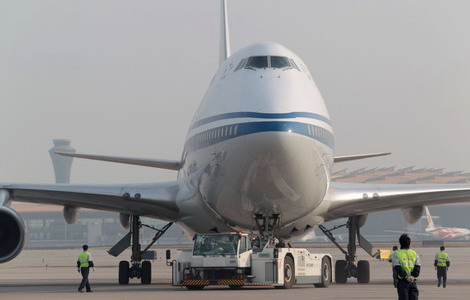
An Air China Ltd plane is fueled with a mixture of jet fuel and biofuel in Beijing. The market value of Chinese aviation biofuel will exceed 120 billion yuan ($19 billion) by 2020 and 30 percent of the country's jet fuel will come from biofuel by then. [Photo / China Daily]
New fuels will reduce greenhouse gas emissions in airline industry
BEIJING - China is expected to use 12 million metric tons of aviation biofuels by 2020, accounting for 30 percent of the country's total use of jet fuel, according to Li Jian, deputy director of the Civil Aviation Administration of China.
The market value of jet biofuels will exceed 120 billion yuan ($19 billion) by 2020, Li said on Tuesday. He said the new carbon-emissions tax the European Union is imposing on airlines will prompt China to develop jet biofuels, which will be put into wide commercial use before 2020, when the country is expected to be using more than 40 million metric tons of jet fuel a year.
Li said China now has the technology needed to produce jet biofuels and only needs to produce the substances more cheaply to sell them commercially.
China currently consumes about 20 million metric tons of jet fuel a year.
Jet biofuel, made from renewable resources, is considered to be cleaner for the environment, giving off less carbon during production than traditional jet fuels.
Statistics from UOP LLC, a subsidiary of Honeywell International Inc, suggest that the use of biofuels can help reduce emissions of greenhouse gases by as much as 85 percent below the level released by burning fossil fuels.
Because of the aviation industry's greater emission of greenhouse gases, by 2020 the Civil Aviation Administration of China wants to improve energy efficiency and reduce emissions of greenhouse gas by 22 percent below what they were in 2005.
China Petrochemical Corp, or Sinopec Group, which contributes 73 percent of the country's output of jet fuel, announced on Tuesday that it had successfully produced jet biofuel at its chemical plant in Hangzhou, Zhejiang province.
The company, which began researching and developing aviation biofuels in 2009, has applied to the aviation administration to undergo an aircraft airworthiness examination. The administration has not said when a decision on the application will be released.
Unless the aviation administration concludes that aviation biofuels are safe, they may not be used in commercial flights.
Sinopec's rival, China National Petroleum Corp, the country's biggest oil producer, delivered 15 tons of aviation oil last June to help Air China Ltd to test out flights powered by biofuel. The fuel had been extracted from the inedible plant jatropha, which is grown in Southwest China.
Air China made a demonstration flight in October 2011 using a fuel that was half made of petroleum-based fuel and half of an aviation biofuel produced from jatropha. The fuel, which was used in one engine of a Boeing 747-400 aircraft, was made by the China National Petroleum Corp and Honeywell's UOP.
China National Petroleum Corp plans to build a refinery to produce 60,000 tons of the biofuel a year by 2014.
Facing pressures to conserve energy and reduce carbon dioxide emissions, the aviation administration is encouraging more companies to help develop aviation biofuels, Li said.
Related Stories
Airlines told not to pay EU green tax 2012-02-07 07:12
China to adopt new jet fuel pricing mechanism 2011-07-12 19:24
EU's carbon tax meets turbulence 2011-12-23 08:31
Nation conducts its first jet biofuel trial 2011-10-29 08:09
- Lifeline thrown to Shanghai's bookstores
- Govt drive aims for fair play on taxis
- High-emission vehicles banned and fined in Beijing
- Business lawsuits in sharp increase in China
- Wealthy residents favor yuan in 2012
- China investment set to increase
- Iron ore prices 'to weaken'
- Overseas money shot in the arm