'Grim outlook' prompts new govt approach
Updated: 2012-02-23 13:13
By Ding Qingfen (China Daily)
|
|||||||||


Developed countries targeted for FDI
BEIJING - The "grim outlook" for foreign direct investment has prompted the government to consider measures to boost investment from developed countries, a trade official said.
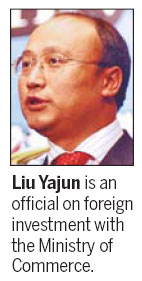
"The outlook for inflows of foreign investment from the United States and the European Union will remain grim during the first half of this year," Liu Yajun, director of the department of foreign investment administration under the Ministry of Commerce, told China Daily.
"We are concerned."
As of late last year China witnessed a decline in FDI from developed nations struggling to keep their economies afloat.
FDI from the US shrank last year by 26.07 percent, from a year earlier, to $3 billion, and investment from the 27-nation EU dropped slightly by 3.65 percent year-on-year to $6.35 billion, according to the ministry. Investment from the eurozone shrank in January by 42.5 percent year-on-year to $452 million.
"We cannot exclude the possibility that US and EU investment will continue to drop, as there are many uncertainties with the global economy," Liu said.
"Studies on reasons behind the decline and measures on how to maintain stable investment from developed economies are being carried out. This will be a priority this year," he said, but declined to disclose further details.
Although it hit a record high of $116 billion, year-on-year FDI growth slowed to 9.72 percent last year, compared with 17.4 percent in 2010.
"The investment from developed economies directly affects the picture of China's FDI in general," Liu said. "And it's not only about quantity, but also about quality," Liu said.
China's main target this year is to "stabilize the scale of its FDI and improve the quality".
High-tech and management experience brought from foreign companies in developed regions will help China transform itself into an innovative economy as pledged in the 12th Five-Year Plan (2011-15), he said.
In guidelines released late last year, the government said it will encourage foreign companies to add or put investment into non-traditional sectors, including advanced manufacturing, high-tech, services and strategic emerging sectors, to transform the growth model.
But while labor costs rise nationwide and countries, including the US, are rolling out preferential policies to attract investment, China is losing its attractiveness as a destination for foreign investors, experts said.
US President Barack Obama announced in June that he is committed to sharpening US competitiveness to attract investment.
A national investment promotion agency, involving 23 government departments, was also set up along with a new "Select US" office.
Companies including Ford, Caterpillar, General Electric and Otis Elevator have announced manufacturing job creation plans in the US in the past couple of years. Some say they plan to bring back to the US production previously done in emerging economies, such as China and Mexico.
"The decline from the developed regions could be attributed to three factors," Liu said.
These are "policies like Select US, unwillingness to invest by companies due to the severe global situation and rising labor costs in China".
But "there could be other reasons and we have to find out."
China is promoting the inflow of foreign investment from developed economies. During a five-day visit to the United States by Vice-President Xi Jinping last week, a trade and investment promotion delegation reached a package of agreements and memorandums with the US worth $38.6 billion, including 25 investment projects by US companies in China.
Xi said in an interview with the Washington Post that China will try to create a fair and transparent investment environment for foreign businesses.
Both countries earlier agreed to start talks on investment agreements this year.
"It's unnecessary to worry too much about the retreat (of investment from the US and the EU)," said Zhang Xiaoji, a researcher at the State Council's Development Research Center.
It is not phenomenal, Zhang said.
Despite complaints ranging from market access to rising labor costs, "China's huge consumer market is more attractive for foreign companies", Zhang said.
Recent surveys by chambers of commerce of the US, EU and Japan showed a high proportion of foreign enterprises are willing to increase investment in China.
"The best way for the government to lure investment back is to open the market wider, reduce market interference and do what it promises," Zhang said.
Commerce Ministry spokesman Shen Danyang said last week that he believed China enjoys comprehensive advantages in absorbing investment, citing fast economic growth, increasingly expanding domestic consumption, and maturing laws and regulations.