Making the middlemen redundant
Updated: 2012-02-20 10:00
By Langi Chiang ?61nd Nick Edwards (China Daily)
|
|||||||||


BEIJING - Operators of the vast network of roads that connect China's fields to the cities can earn gross margins of up to 90 percent, making them the most profitable of the supply-chain middlemen who reap the best rewards from China's harvests.
|
 |
|
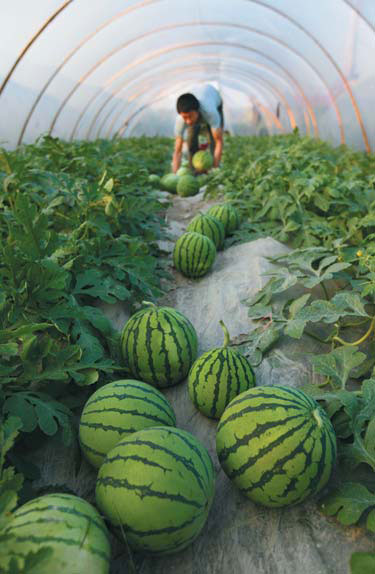
A farmer in a watermelon growing tunnel in Haikou, Hainan province. Middlemen in the supply chain of agricultural goods have been accused of pushing up food prices in China.[Photo/China Daily] |
That means that the 18 percent rise in average rural incomes still leaves farmers like Jiang Bo lagging badly behind their urban cousins.
"Even when our vegetable prices are at their highest levels, we still do not make much money because there are too many middlemen in the supply chain," said Jiang, a farmer in eastern China's Shandong province, who said she is weighing whether to quit the fields for the factory this year.
Cutting logistics costs - which equated to 10 percent of the nation's GDP in 2010, double that of Japan - has been pledged for years in the government's annual agricultural plan to increase rural income and spread harmony through society.
It's not easy, given that raising income for producers implies rising prices for consumers, and China has vowed to fight inflation.
"We must support direct selling, clear all kinds of charges and reduce the distribution costs of agricultural products," Premier Wen Jiabao wrote in an essay published in the influential magazine Qiushi, or "Seek Truth", in January.
Since the start of the year, a tax tweak for vegetable distributors abolished the 13 percent levy they'd previously paid.
But it's cutting the costs of the middlemen that offers the most potential for China to spread more benefits to the farmers.
An investigation by Hu Dinghuan at the Chinese Academy of Agricultural Science showed that the price of tomatoes rose from 2 yuan ($0.31) per kilo leaving the fields to 5 yuan per kilo at the warehouse door of supermarkets in 2007.
"The distribution costs must be even higher nowadays because of rising fuel prices," he said.
The government is mulling a cut in highway toll fees and has already started a nationwide check on rampant charges at toll gates. Shanghai made the Hujia Expressway - China's first highway, opened in 1988 - toll free on January 1.
China has previously suspended toll charges to curb inflation. When prices soared in 2008, the National Development and Reform Commission scrapped toll fees for trucks carrying fresh vegetables, driving down the annual rate of vegetable inflation from a peak of 46 percent in February to 22.7 percent in March. The figure fell to minus 2.1 percent by November of that year.
Zhao Yuzhong has his own way to cut through the middlemen.
He and his fellow farmers on the northern outskirts of Beijing are pioneers in delivering fresh vegetables directly to city consumers, getting produce from the field to the table in less than five hours.
"We now earn more than twice what we did before and our price is 30 percent lower than that offered by the supermarkets," Zhao said.
The main challenge when they set up their company in May was how to reach as many families as possible. Since then, the company has already broken even and Zhao reckons annual revenues could double to 2 million yuan this year.
Its transportation costs are now less than 1 percent of sales.
Both Jiang and Zhao said the retailers charged high fees to sell farmers' products.
Still, squeezing out the middlemen will not completely compensate for the seasonal price swings that can wipe out small farmers.
Jiang suffered big losses selling her Chinese cabbage crop at 0.1 yuan per kilogram after a bumper autumn harvest. Prices in the summer were 1.4 yuan per kilo.
"Vegetable prices are very seasonal. The best way is for the government to set a floor at times of oversupply, buy vegetables directly from us to build up reserves and release them later to even out the price fluctuations," Jiang said.
Beijing is testing the idea of vegetable reserves, basing its plan on the experience it has had in managing grain stores.
Reuters
Related Stories
Positive policies key to harvests 2010-12-21 08:05
VP hails CPC's rural policies as greatly successful 2011-06-27 22:35
Curbs on home purchases to be 'phased out' 2011-10-28 07:24
China curbs on realty speculation long-term policy: Expert 2011-06-02 09:49
- More US films set for China
- Experts say Apple has trademark weakness
- Exports to rise in emerging markets
- Gaming set for fast growth in new play areas
- Apple's iPhone loses China market share
- Li stresses innovation, higher living standards
- Xi reiterates support for Europe
- Radiation rumors electrify Cruze owners