Shanghai to become yuan center
Updated: 2012-01-31 09:12
By Wu Yiyao and Oswald Chen (China Daily)
|
|||||||||


A new plan aims to turn Shanghai into the global financial hub
SHANGHAI / HONG KONG - Shanghai will become the global center of yuan trading, clearing and pricing by 2015, in line with a State plan to make the city an international financial hub by 2020.
|
 |
|
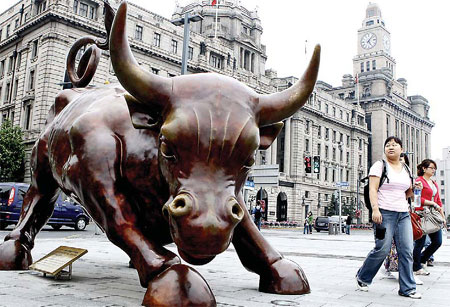
Pedestrians pass a bull statue in the Bund of Shanghai. The city has unveiled plans to become a world financial center by 2015. [Photo/China Daily] |
Financial experts said the plan will not put the city in direct competition with Hong Kong, which is already the offshore yuan center. That's because the two cities will offer different yuan-based products and services to different clients.
The plan, jointly published by the National Development and Reform Commission and the Shanghai Municipal Government on Monday, sets out the main objectives for Shanghai to become a financial center. Key to those objectives is to raise the annual volume of trade in Shanghai's financial markets (excluding the foreign exchange market) to 1 quadrillion yuan ($158 trillion) by 2015.
In 2010, Shanghai's financial markets (excluding the foreign exchange market) registered a trading volume of 386.2 trillion yuan, 10 times of that in 2005.
The plan says the daily mid-point price published by the central bank in the onshore yuan market would be the benchmark for both domestic and foreign yuan trading markets, and the government-backed Shanghai Interbank Offered Rate, or Shibor, would be the benchmark for yuan credit everywhere.
China will also encourage overseas companies to sell yuan-denominated shares in its domestic stock markets, but no timetable has yet been released.
Shanghai will also strive to increase its influence in global financial markets, especially the yuan-product market, according to the plan.
By 2015, Shanghai's financial markets will witness a surge in the number of overseas investors and the growing global impact of its stock market's main indexes and commodities futures prices.
The plan says Shanghai will enhance its financial services. By 2015, the financing volume of Shanghai's financial markets will account for 22 percent of the city's total financing volume, reaching 30 trillion yuan, double that of 2010.
Foreign-funded financial institutions will be encouraged to set up regional or global headquarters in Shanghai.
There were 1,049 financial institutions in Shanghai as of the end of 2010, 439 more than five years earlier.
As many as 320,000 financial industry professionals will be working in the city by 2015, including a large number of high-caliber talent, according to the plan.
In 2009, the State Council, China's cabinet, announced that Shanghai would be built into an international financial hub.
The city boasts China's biggest gold exchange, the headquarters of the country's foreign-exchange trading system and a major commodities futures exchange.
The plan demonstrates the determination of the central government to make Shanghai an international financial center, and it is significant for the city's development and reforms in a bid to thrive in the global financial market, according to the Shanghai Municipal Government.
"The plan indicates that China is determined to strengthen the financial function of Shanghai in a bid to compete with top global financial centers. The pricing of the renminbi will be decided mainly in the onshore rather than the offshore market, a message that has been conveyed since the NDRC announced it - the plan is a significant move," said a precious metal trader with the Shanghai office of a London-based bank, who spoke on condition of anonymity.
"If the goals of the plan are achieved on schedule, Shanghai will attract more multinational corporations to establish their headquarters there and more investment banks will see the incentives of developing their business in Shanghai, which means the city will assume many of the functions once carried out by Beijing," said a trader with a Beijing-based investment institution.
Meanwhile, Hong Kong and Shanghai should not be in a position of competition in the yuan business, said Professor Chong Tai Leung of the Chinese University Institute of Global Economics and Finance in Hong Kong.
"Shanghai is the onshore yuan currency market and Hong Kong is the offshore market, therefore each city has its own niche in the yuan business that the other cannot compete with," said Chong.
"Both cities are complementary in their roles of developing the yuan business, as they can offer different yuan-based products and services to different clients."
In addition, Hong Kong still has advantages that it can leverage to remain the offshore yuan financial center.
"Hong Kong can still attract talented financial professionals and possesses a sophisticated legal system that offers arbitration services to global clients. In this sense, at this stage Shanghai still cannot compete with Hong Kong," said Chong.
He stressed that in the initial stages of yuan internationalization, Shanghai and Hong Kong should have more room for cooperation rather than competition in promoting the wider use of the currency in trade settlement and investment products.
AFP contributed to this story.
Related Stories
Shanghai plans to raise the number of underwriters 2011-09-07 07:41
Shanghai promotes cultural, travel and sports events in HK 2011-08-18 13:23
Harbour One Tower awarded LEED certification 2011-07-18 17:13
Shanghai set to launch international board in 2011 2010-12-03 13:43
- Wen: Government debt safe, controllable
- Shanghai to become yuan center
- 28 provinces release 2011 economic data
- Low-income housing gets 175b yuan loans
- Eager buyers skirt license plate limits
- China's largest electric car charging station opens
- TV through the Internet steps forward
- Shandong tops China's labor export list