Foreign auto investment no longer 'encouraged'
Updated: 2012-01-09 14:27
By Han Tianyang (China Daily)
|
|||||||||


Bid by regulators to strengthen local car companies and domestic R&D
BEIJING - In a bid to limit overcapacity and improve the strength of domestic automakers, regulators will no longer encourage foreign investment in vehicle manufacturing in China, according to guidelines issued last month.
|
 |
|
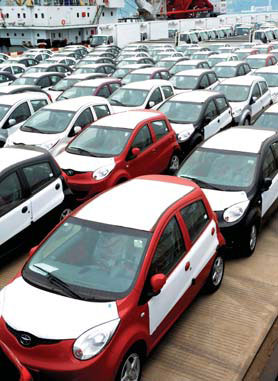
Cars waiting at Lianyungang port in Jiangsu province for shipment to Africa. Economic planners are increasingly concerned about excess production capacity, yet want to boost the transfer of technology.[Photo/Chinadaily] |
Jointly formulated by the National Development and Reform Commission (NDRC) - the country's top economy planner - and the Ministry of Commerce, the latest policy guidelines for foreign investors will take effect on Jan 30, replacing rules from 2007.
Vehicle manufacturing will be removed from the "encouraged" category of industries that welcome foreign investment.
Manufacturing of engines and other key components, as well as R&D on key technologies, remain on the list of encouraged sectors for investment. Batteries and electric motors for new energy vehicles were added to the list for the first time.
Market observers see the change as a signal that China will raise the threshold on approvals of new Sino-foreign joint ventures or expanded production by exiting partnerships.
Just a few decades ago, China's auto market was tiny and the industry lacked the needed foreign capital and technology, said Zhang Yu, managing director of industry consultancy Automotive Foresight (Shanghai) Co Ltd.
But the environment changed dramatically as the nation became the biggest auto market in the world. Traffic congestion and emissions are now causing increasing public concern, so limiting excessive production is understandable, Zhang said.
Almost all major carmakers in the world already make vehicles at their joint ventures in China. Only a few - such as Renault, Chrysler and niche or super-luxury brands - are without local production.
China's total vehicle output and sales both surpassed 18 million units in 2010. Year-end figures for 2011 are expected to show modest increases over those numbers.
Yet the new policy might have little impact on limiting foreign investment in the auto industry, analysts said.
Tax breaks for foreign investors might be reduced or eliminated, but that won't stop carmakers if they have long-term development plans in China, said Lin Huaibin, an analyst with IHS Automotive in Shanghai.
Officials at the China operations of Volkswagen and Toyota declined to comment on the new policy, but said their investment plans in China won't change.
General Motors said in a statement that the company expects the new guideline will have minimal impact on its business.
An unnamed NDRC official was quoted in a recent Xinhua News Agency report saying the latest guideline does not mean the government is tightening policies on foreign investment in the auto industry.
Instead, the regulators aim to guide foreign investment into projects with better market prospects and higher returns, the official said.
By encouraging investment in new energy vehicles and components, the government is showing it wants foreign investors to cooperate more on R&D so their local partners move beyond just assembling vehicles for a share of the profit, said Lin from IHS .
Despite the rapid growth in vehicles sales, China's domestic auto industry still lacks competitive self-developed brands, especially in the medium and high-end segments. According to the China Association of Automobile Manufacturers, domestic brands account for less than 30 percent of sales in the sedan market.
As long as foreign carmakers continue to add capacity and sell more cars, the space for development of domestic carmakers will continue to be squeezed, some warned.
The government clearly plans to allocate additional capacity in the quest to build domestic brands and develop new energy vehicles, said Zeng Zhiling, director of JD Power-LMC Asia Pacific Forecasting.
Related Stories
Chang'an to expand into European markets 2011-09-15 11:40
Chengdu rises as an auto manufacturing highland 2011-07-26 09:07
European rethinks on China's auto M&A 2011-05-20 10:52
US parts giant Delphi ratchets up for growth in Asia-Pacific 2011-02-14 14:06
China's auto industry needs innovation 2011-10-18 15:07
- Wen urges for more support to real economy
- Caterpillar expands China research center
- China must brace for global shocks: PBOC
- Cartoon industry gets more animated
- Land supply up 37% in China last year
- China to maintain monetary policy 'prudent': PBOC
- Beijing to continue housing purchase restrictions
- Online video sites fight over copyright