US 'must end illegal duties'
Updated: 2011-12-22 09:36
By Li Jiabao and Ding Qingfen (China Daily)
|
|||||||||||


|
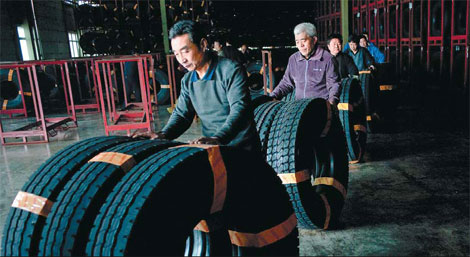
Factory workers roll tires through a warehouse at a tire factory in Jining, Shandong province. The Ministry of Commerce says the US has been imposing countervailing duties against Chinese products for many years in spite of WTO rules. [Photo/Bloomberg] |
Statement from ministry follows ruling by federal appeals court
BEIJING - China has urged the United States to stop imposing countervailing duties on Chinese products while refusing to recognize China's market economy status.
The comment followed a ruling by a US court against the US Commerce Department's imposition of such duties on Chinese tires.
"The US has been imposing countervailing duties on Chinese products for many years, which is against World Trade Organization (WTO) rules and US law," the Ministry of Commerce said in a statement on its website on Wednesday.
"We hope the US corrects the wrongdoing as soon as possible when it holds China as a non-market economy," said a spokesman for the ministry's Bureau of Fair Trade for Imports and Exports.
The statement came one day after the US Court of Appeals for the Federal Circuit in Washington said US law does not allow the Commerce Department to impose countervailing duties on products from non-market economies such as China.
The US court rejected the argument by Titan International Inc, the biggest US maker of off-road tires, and the AFL-CIO labor federation, against imports of tires from China.
Titan and the labor group filed the case in June 2007, and they were supported by the US International Trade Commission in August 2008, when it ruled in favor of anti-dumping and countervailing duties.
"The latest US court ruling is a great victory for Chinese companies, which have been the victims of endless anti-dumping and countervailing investigations by the US Commerce Department," said Tu Xinquan, associate director of the China National Institute of the WTO at the University of International Business and Economics.
"The rejection of countervailing duties will reduce the pressure on the Chinese government and enterprises and help China develop a better export environment."
Since November 2006, the US Commerce Department has started 30 anti-dumping and countervailing investigations that were not in accordance with US law, according to the ministry's statement.
"The frequent use of trade-remedy measures reflects trade protectionism. The US Commerce Department imposed countervailing duties against Chinese enterprises in addition to the anti-dumping duty under the subrogate country system, which is unfair to Chinese enterprises," said the statement.
Anti-dumping duties apply to goods sold overseas at or below the price in the home country while countervailing duties aim to offset the benefits of government subsidies to industries.
As the global debt crisis deepens and the US is troubled by high unemployment, trade-remedy cases, including anti-subsidy cases started by the US against Chinese goods, have been rising.
In a recent case, the US imposed additional duties on Chinese solar cells on Dec 2, saying that subsidies for the products harmed equipment makers such as the US unit of SolarWorld AG.
Zhong Shan, vice-minister of commerce, said recently that China's exporters will have to face a much more severe business environment, because of shrinking global demand and rising trade protectionism, especially from the US.
Although Chinese companies that were subject to countervailing duties in past years will not get their money back, Sun Zhenyu, chairman of the China Society for World Trade Organization Studies, said that "the US will not easily start countervailing investigations in the future".
Chinese exporters have incurred huge losses from US anti-dumping cases. For example, additional duties on Chinese solar cells could mean a loss of $2 billion for domestic producers, the Beijing Times newspaper reported in November.
Despite the court ruling, the US government still has ways to penalize Chinese imports, warned experts.
"It is more likely the US Commerce Department will push Congress to change the relevant laws to penalize products from China," Tu said.
Related Stories
US countervailing duties unfair 2007-01-26 10:52
US initiates antidumping and countervailing duty investigation on Chinese aluminum extrusions 2010-04-22 13:10
US sets countervailing duties on tubular goods from China 2009-11-25 09:54
Gov't: US countervailing duties are unfair 2007-01-26 11:09
- Software deadline gives IPR big boost
- US 'must end illegal duties'
- Daimler reportedly seeks CIC investment
- Indian solar probe may hurt sector
- Mainland to maintain IPO lead
- Smartphone maker Xiaomi gets VC funding
- Prudent monetary policy to continue: PBOC
- China to step up local pension fund management