When Shenzhen meets Peking University
Updated: 2011-11-28 15:19
By Song Jingli (chinadaily.com.cn)
|
|||||||||||


|
 |
|
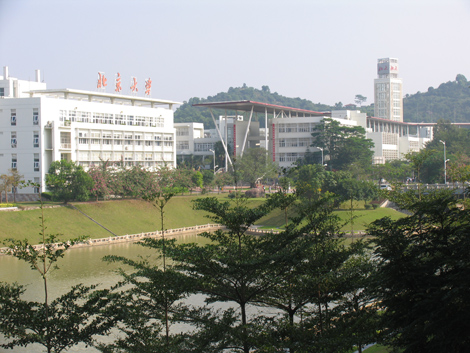
The campus of Peking University Shenzhen Graduate School on Nov 20, 2011. |
On the one hand, it is Peking University, which is China's top university and the dream university of numerous Chinese students. On the other hand, it is Shenzhen, which is the biggest winner from China's opening up and reform policy and later named a paradise for immigrants and entrepreneurs. Ten years ago Peking University set up a satellite campus in Shenzhen. What has been going on between these two pioneers? From Peking University Shenzhen Graduate School, which is located in Nanshan district of Shenzhen, you can get a glimpse of China's education reform. On Nov 20, Chinadaily.com.cn interviewed Hai Wen, vice-president of Peking University and chancellor of Shenzhen Graduate School.
China Daily: Why did Peking University and Shenzhen Municipal Government decide to set up a satellite campus in Shenzhen 10 years ago?
Hai Wen: It's hard for me to know the intentions of the leaders of both parties at that time. But I can see that it was because of the needs of both sides.
When a city's economy has developed to a certain degree, its need for good-quality education will be apparent. That is probably where Shenzhen was 10 years ago but there was only one university.
Peking University wanted further development but it was hard to implement some of its reforms in Beijing.
China Daily: Specifically, how did Shenzhen meet its need for higher education?
Hai Wen: It was a two-pronged approach. One, it introduced top universities such as Peking University and Tsinghua University to Shenzhen. And two, it set up its new universities locally, such as the South University of Science and Technology of China.
China Daily: As far as I know, the Shenzhen Graduate School was the second choice of undergraduates applying for Peking University in 2007. How are things now?
Hai Wen: The Shenzhen Graduate School stopped accepting applicants whose first choice was to study at the graduate school at the Beijing campus in the year 2009. Now, we even refuse some of the Peking University undergraduates, who apply to attend the HSBC Business School.
The Shenzhen Graduate School has some innovations in discipline-setting and school management, and is attractive to China's best undergraduates. Graduates here will be proud that they have studied at the Shenzhen campus.
China Daily: Some Shenzhen government officials argued that students who graduated from Peking University Shenzhen Graduate School did not stay in Shenzhen for work, or they went back to Beijing for employment. Would you please explain this?
Hai Wen: At the beginning, both students and teachers were not willing to go to Shenzhen. Later, students were required to study at the Shenzhen campus for one or two years. They began to know this city and some of them were willing to stay.
China Daily: Some government officials argue that it's hard for local companies to adopt technologies developed by the Peking University Shenzhen Graduate School.
Hai Wen: To some extent, it is true. For example, some technologies developed by the School of Chemical Biology & Biotechnology are not easily industrialized by small and medium-sized companies in Shenzhen. The school may need to cooperate with companies like Pfizer. But you cannot expect too much of Peking University in this respect because Peking University is not a technology university.
China Daily: What can Peking University do for Shenzhen?
Hai Wen: Peking University can promote Shenzhen's service industry and help to restructure its economy.
The HSBC Business School aims to provide society with talents in the financial service sector. In the year 2010, half of graduates from this school chose to work in Shenzhen.
The School of Transnational Law will also provide talents who have mastered Chinese law and American law.
Peking University Shenzhen Graduate School also provides further education for in-service local government officials and local entrepreneurs.
In addition, Peking University also serves as a platform to connect overseas talents with Shenzhen, helping it become an international city.
It would've been very difficult for Jeffrey S. Lehman, former president of Cornell University, to come teach in Shenzhen if not for Peking University. Jeffrey S. Lehman is the founding dean of the School of Transnational Law.