Climate change threatens drop in grain harvest
Updated: 2011-11-09 14:28
By Jin Zhu (China Daily)
|
|||||||||||


|
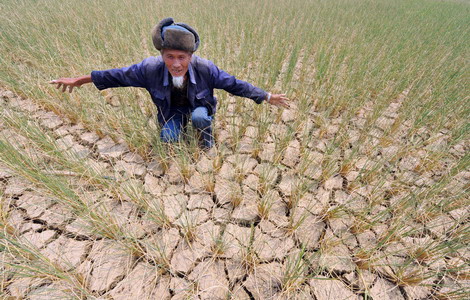 Luo Jinming, a 76-year-old farmer in Guiyang, capital of Southwest China's Guizhou province, in a field of desiccated paddy on Aug 27. [Photo / China Daily]
|
Tang Huajun, deputy dean of the Chinese Academy of Agricultural Sciences (CAAS), said yield loss on the country's three main crops - rice, wheat, and corn - is foreseeable if the country fails to take effective measures to offset the impact of climate change.
Tang made the remarks during a two-day international conference on climate change and food security that ended on Tuesday in Beijing.
"The impact of climate change, especially extreme weather and plant diseases and insects, will cause a bigger grain production fluctuation in China and bring more serious threats to the country's food supplies," he told China Daily.
China's grain output, which recorded 546.4 million tons in 2010, is expected to jump to a record high of more than 550 million tons, marking the eighth consecutive year for increased production, according to the Ministry of Agriculture.
Meanwhile, the impact of climate change, as well as arable land loss and water shortages on the country's food supplies, has sparked growing concerns among agricultural professionals about the world's biggest grain producer.
"The country's rice output may suffer 4 to 14 percent decline in 2050. Wheat and maize could fall by 2 to 20 percent and 1 to 23 percent if climate change continues," Tang said.
The total output coming from the three main crops always accounts for more than 80 percent of China's total grain production.
According to Ministry of Agriculture projections, the country's total grain demand will reach 572.5 million tons by 2020, an increase of 47.5 million tons compared to 2010.
"China will be faced with a heavy task ensuring its food security, since negative effects of climate change has become more obvious and these are increasing," Qu Sixi, deputy director of the ministry's department of international cooperation, said at the conference.
For instance, the country's arable land affected by flooding increased from 5 million hectares per year in the 1970s to 10 million hectares per year in the 2000s, CAAS statistics showed.
Also, the annual grain harvest loss due to pests and plant diseases increased from 6 million tons in the early 1970s to 13 million tons in the mid-2000s, official figures showed.
Wang Jimin, deputy director of CAAS' agricultural economics and development institute, said that the country might have to increasingly import agricultural products from overseas markets in the future.
"For instance, domestic supply of maize will reduce as production is limited, while the country's fodder consumption is rising," he said.
Also, as the country will strive to satisfy arable land demand to realize its self-sufficiency in grain supply, the import of other agriculture products, such as cotton and oil crops, will increase in future, he said.