China implements tax cuts to support small firms
Updated: 2011-11-02 09:24
(Xinhua)
|
|||||||||||


BEIJING-- China carried out major tax cuts on Tuesday designed to benefit the nation's crisis-hit small and micro-sized firms -- including street vendors -- and also help curb inflation.
The value-added tax (VAT) threshold for small enterprises increased to between 5,000 yuan ($791.14) and 20,000 yuan, in terms of monthly sales revenues, from the previous threshold of 2,000 to 5,000 yuan, according to a statement released by the Ministry of Finance (MOF) on its website.
 |
|
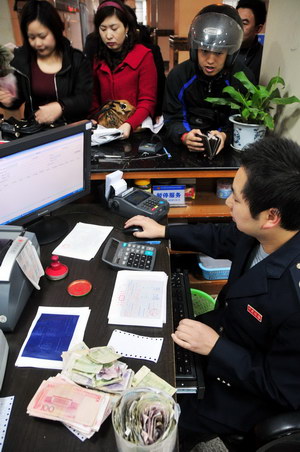
A staffer collects tax on Nov 1, 2011, in the local taxation office in Nanchong city, Sichuan province. [Photo/Xinhua] |
Meanwhile, the threshold for levying the business tax for small enterprises was raised to 5,000-20,000 yuan from the previous 1,000-5,000 yuan.
The new threshold is designed based on the business traits of small and micro businesses and aims to relieve their tax burden, said Bai Jingming, a researcher with the MOF.
VAT is a consumption tax, and because small businesses are mainly labor-intensive and seldom purchase machinery, a higher tax threshold could raise their tax deductions, Bai explained.
As small businesses are mainly engaged in the areas of consumer spending such as transportation, hair salons and tourism, a lower business tax will be good news for them, Bai said.
The latest cut is expected to benefit the 300,000 micro-sized businesses significantly.
It takes more care of the most-needy groups and will not affect the government's fiscal strength, said Zhang Bin, a researcher with the Chinese Academy of Social Sciences.
The previous tax cut, implemented in 2003 when the SARS epidemic dealt a heavy blow to small businesses, saved 4.93 billion yuan in taxes that year.
Hu Yijian, a financial professor with Shanghai Jiao Tong University, estimates the latest cut will reduce tax revenue by 400 billion to 500 billion yuan.
It's a small share of the government's more than 7 trillion yuan of annual tax revenue, but will act as a strong boost to the enterprises, he said.
Since the beginning of the year, a slower domestic economy and tightened monetary policy have exacerbated small businesses' chronic problem of gaining access to financing.
In the city of Wenzhou, known for its successful entrepreneurs, at least 78 cash-strapped business people have gone into hiding -- and two have committed suicide -- to invalidate more than 10 billion yuan in debt owed to individual creditors pooled from the private lending market, according to a Xinhua investigation.
Small- and mid-sized enterprises create about 80 percent of the country's jobs, but still have difficulty securing bank loans, as Chinese banks prefer to lend to larger companies, especially state-owned enterprises.
The State Council, or China's Cabinet, earlier this month took a new approach toward helping the country's cash-strapped small- and micro-sized enterprises, pledging stronger financial and fiscal support to allow them to plow through current economic difficulties. The latest tax cut is part of the plan.
Since the government did not specify the duration of the new policy, we can expect it will be a long-term policy, Bai Jingming said.
In addition, the government also scrapped the stamp tax levied on small businesses when they ink lending deals with financial institutions. The policy will go into effect between Nov 1, 2011 and Oct 31, 2014.
Related Stories
China raises VAT, business tax thresholds 2011-11-01 10:08
China works to replace turnover tax with VAT 2011-10-27 09:17
Program to facilitate SME financing 2011-08-19 15:18
Alibaba broadens SME loans 2011-03-22 10:39
Mainland, Taiwan SME co-op stressed 2011-02-26 16:04
- Farm produce prices fall for third week
- $31b govt stimulus to revive railway projects
- Home prices slide again in October
- BASIC countries reach Kyoto consensus
- China implements tax cuts to support small firms
- Imported iron ore prices fall
- Key factory indicator falls in Oct
- Gold price still on upward trend