Private fuel stations scramble as diesel supplies tank
Updated: 2011-10-21 10:48
By Wang Ying and Zhou Yan (China Daily)
|
|||||||||||


|
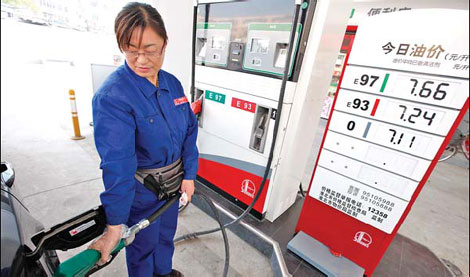
A worker fuels a vehicle at a service station in Huaibei, Anhui province. Private-sector gas stations are experiencing an unusually severe diesel shortage. [Photo/ China Daily] |
SHANGHAI / BEIJING - Private-sector gas stations, which account for almost half of the nation's total, are experiencing a severe diesel shortage that won't pass quickly, analysts said.
Diesel shortages arise every September and October, the traditional peak months for diesel use, forcing private-sector gas stations to scour the country for supplies. But the shortfall is worse than usual this year.
The National Development and Reform Commission (NDRC), the country's top economic planner, said on Oct 8 that it would cut retail prices for gasoline and diesel by 300 yuan ($47) a ton. It's the first time the NDRC had revised the price of the refined oil product in 16 months.
But the price cut wasn't good news for everyone. More than 30 members of the Commercial Petroleum Flow Committee of China complained of diesel shortages and urged the central government to intervene, said Zhao Youshan, chairman of the committee, on Wednesday.
Zhao said he decided to write a report to the central government after learning of the members' difficulties, and he urged the NDRC to guarantee supplies to private-sector filling stations, as stated in related regulations.
According to Zhao, more than 10,000 of the nation's private-sector gas stations face diesel shortages. There are 44,005 of these stations in China, or 46 percent of the total number.
Experts said the diesel shortage resulted from price cuts for domestic refined products being imposed amid rising world crude oil prices.
"The price change has eroded refiners' profit margins, and they are unwilling to produce oil products, leaving many facilities running at low capacity," said Zhou Dadi, former director of the energy research institute of the NDRC.
"It's impossible for us to sell at such low levels. We have to hold our products until prices climb back to a reasonable level," said a China National Petroleum Corp manager in charge of the diesel trade, speaking on condition of anonymity.
As a profit-driven company, the current price is unacceptable, the source said.
Some analysts said that big State-owned oil companies are also trying to take advantage of current shortages to step up acquisitions of local refineries.
Yuan Xinxiang of the PetroChina media department said that the diesel shortage reflected the combined effects of the traditional peak season and the unwillingness of private-sector refineries to produce diesel.
Sources at the China Chemical and Petroleum Corp, also known as Sinopec, denied media reports that the company's sales staff had said they had no responsibility to guarantee the diesel supply of private gas stations.
Statistics provided by Sinopec show that starting this month, retail sales of diesel averaged a record high of 280,000 tons a day at its sales branches nationwide, representing year-on-year growth of 9.9 percent.
Sinopec stressed that two things must be done to resolve the supply problem. The first thing is an improvement in the product structure of ethene and the production efficiency of ethene derived from diesel.
Second, the company has to strengthen market monitoring and resource allocation to reduce the logistics cost of diesel.
Wang Jintao, an analyst at chem365.net, an online information provider for the petrochemical industry, said that regular autumn maintenance at local refineries had exacerbated the shortfalls. "The market has yet to absorb the recent cut in retail diesel and gasoline prices in October and (producers are) reluctant to sell diesel at such low levels, given the backdrop of volatile global oil prices," Wang said.
China's gas supply is mainly controlled by PetroChina and Sinopec, which together hold a dominant market share of more than 80 percent.
"China's current oil output (leaves the nation) far from a supply shortage. Supply and demand are quite equal," said Guo Zhe, an analyst from Xiangcai Securities. According to Guo, the nation consumed 110.95 million tons of diesel in the first eight months of this year, while supplies totaled 111.02 million tons.
Zhao claimed that the current diesel shortage was artificial. He said the reason that State-owned gas stations have no such shortage is that private gas stations cannot get supplies that are monopolized by State-owned companies.
Related Stories
China's oil, gas surveying investment up 6.7% 2011-10-20 11:28
China sees stable supply of refined oil products in Jan-Sept 2011-10-17 17:37
No new leak point in seabed found at Bohai oil platforms 2011-10-17 13:11
Cleanup in bay after oil spill; disaster fund nears 2011-10-17 11:35
- CapitaMalls Asia plans to expand Chinese projects
- China's Wolong buys ATB Group for $138m
- China's social financing falls $194b in Jan-Sept
- CNPC plans steady overseas expansion
- Ma urges Yahoo! to respond to offer
- Center Group resumes production
- Direct debt for local govts
- New service to boost mobile shopping in China