Rail dream still on track to unite continents
Updated: 2011-10-12 11:51
By Alfred Romann (China Daily)
|
|||||||||||


|
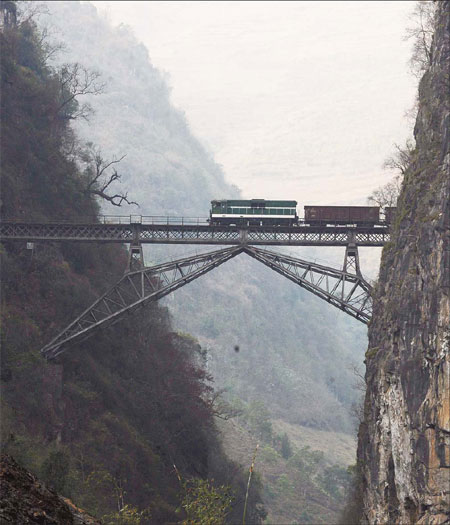
A train runs on the 100-year-old railway linking Kunming in China with Vietnam. The line is only a small part of the Trans-Asian Railway. [Photo/Xinhua] |
Major problems remain but ambitious network hopes to link Asia to Europe, Alfred Romann reports from Hong Kong.
Creative locals use "bamboo trains" to travel along Cambodia's abandoned railway lines. These homemade vehicles ferry food and people and are powered by adapted water pumps. Technology at its most basic but Cambodia's railways could yet be part of an ambitious network linking Asia to Europe.
In 2009, the Asian Development Bank provided $84 million to rebuild Cambodia's 600-km railway network. The whole project should cost $141 million and is due for completion by 2013.
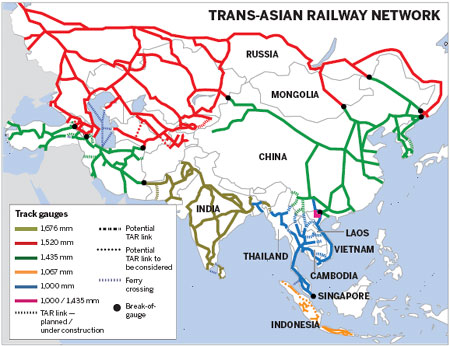
Cambodia's railways are among several missing links in the Trans-Asian Railway (TAR) project, an 117,000-km rail network, 10,500 km of which has yet to be built. Rehabilitating Cambodia's rail network is integral to the project that would link Singapore to Kunming, and beyond to Central Asia and, eventually, to Turkey and mainland Europe.
Envisioned in the 1960s, TAR would ultimately link the fragmented national railways in 28 countries into a unified transportation system.
"The completion of the missing links in the network and its efficient operations are key to the region's economic integration," according to Pierre Chartier. He is economic affairs officer in the transport division of the United Nations Economic and Social Commission for Asia and the Pacific, which is driving the project.
The scope of this undertaking is massive. Some countries in the network have no railways to speak of; others have dilapidated ones.
Making connections
Chinese investment in domestic and foreign projects is driving forward the development of TAR, but more than money is required. Missing links between countries have to be filled and infrastructure built to overcome significant technical differences before a single, unified rail system can run smoothly across the continent. For instance, the width of tracks and, in turn, the axles of trains often vary from country to country.
"Financing and building railway infrastructure is easy. The challenge is integrating the Greater Mekong Subregion railways, which developed in splendid isolation from each other since World War II, to the point where they can operate effectively," said Peter Broch, senior transport economist at the Asian Development Bank.
"Effective cross-border rail traffic would provide medium- to long-distance land transport, thereby improving economic efficiency," Broch said. Transport and transaction costs would be reduced, and national economies could be better linked.
A 128-km link from the small city of Loc Ninh, along the Cambodian border, to Ho Chi Minh City will provide one of the missing links. It is part of a national plan Vietnam developed in 2002 to rehabilitate and turn Vietnam Railways into a corporation. Once that bit of the system is laid out and operational, it will be up to Cambodia to link it up with the wider transnational network.
|
Source: United Nations Bridget O'Donnell / China Daily |
Related Stories
China's rail transport sees increases in first three quarters 2011-10-08 15:00
Rail contractors forced to suspend projects as govt's payments dry up 2011-09-30 13:23
China, Russia rail against EU aviation emission scheme 2011-09-28 14:25
China invests $199b for urban rail 2011-08-26 10:01
- Policy about-turn in Foshan home limits
- Taobao works to bring order to booming e-market
- AstraZeneca to build $200m center in China
- WTO talks at the crossroads
- China buys Japan debt as crises in West grow
- Currency act shortsighted
- Bailout of Wenzhou private firms
- Farm produce prices slightly up last week