New home front opens up in divorce
Updated: 2011-08-19 16:08
By Li Jing, He Na and Duan Yan (China Daily)
|
|||||||||||


|
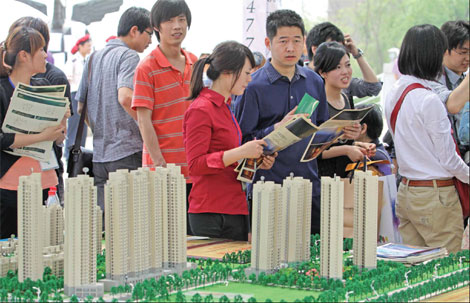 If love is in the air, could a real estate deal be close behind? This matchmaking fair in Wuhan, Hubei province, was sponsored by a developer who offered discounts to encourage potential homebuyers. [Photo/China Daily]
|
When romance ends, disputes on property ownership begin
Beijing-based lawyer Zhang Jing says he has been bombarded with inquiries since Aug 13, when divorce property rules changed.
Previously, marital assets were divided equally unless either party was found guilty of bigamy, domestic violence, abandoning the family or living with a lover for three months or longer.
Now, the partner whose parents bought the property for the couple will retain sole ownership in a divorce.
The change is part of a new judicial interpretation of the marriage law.
As a result of the change, one of Zhang's clients insisted that her name be registered as co-owner of the matrimonial apartment, which her husband's parents purchased, so she would have a right to claim the asset if the marriage fell apart.
"It was unpleasant for the young couple and their families. But in the end, she got what she wanted," Zhang said. "After all, the two are in love and serious about getting married."
That young woman is not unique. Another, who refused to be named, went so far as to tell her husband she wouldn't have a baby or take care of his parents unless she was registered for ownership.
While some people complain about having to discuss divorce even before tying the knot, the Supreme People's Court said the new rulings are aimed at heading off disputes over the property ownership in divorce cases.
Every day, more than 5,000 Chinese couples end their marriages. The Ministry of Civil Affairs reports that about 946,000 couples applied for divorce in the first half of 2011. Last year there were 1.96 million, a 14.5 percent increase from the previous year. The average annual increase since 2003 is 7.6 percent.
With the country's soaring real estate prices, property has become a lucrative asset and is frequently contested in divorce cases. Legal experts say the new explanation offers clear-cut reference for judgment in divorce lawsuits involving property.
Wang Xiuquan, a senior matrimonial lawyer with Beijing Chang An Law Firm, says parents who buy their children houses are the most protected group.
"Fewer and fewer young people can afford a home by themselves without parents' support," he says. "Many parents even put their entire life savings into a home for the children's marriage. I think the new interpretation will protect the rights of these parents."
"Parents who buy their children homes used to worry that if their children divorced it could result in the loss of family property," says Sun Jungong, a spokesman for the Supreme People's Court.
When parents help . . .
Wang Hua, who is now 38, and Li Xiang, 39, married in May 2000 and had a daughter in March 2002. They lived in a 95-square-meter apartment in Wanshoulu, Haidian district of Beijing, that Wang's parents bought in 2003 for 1.2 million yuan (130,388 euros).
"We lived in perfect accord with each other before my daughter was born," Wang says. "However, the sweet dream was short-lived." She says her husband became obsessed with mahjong and spent little time with the family.
Although Li agreed to divorce, he insisted that he owned half the property. The apartment was purchased after marriage, he says, so it should be viewed as a gift from Wang's parents to the couple.
Under the new explanation, the court can identify the apartment as Wang Hua's personal property as long as her parents can present evidence such as remittance notes, money transfer bills, bank records and the property certificate bearing her name, lawyer Wang Xiuquan says.
The new explanation also says that if a home is purchased by both sets of parents and the marriage ends in divorce, the value of the asset can be divided according to each side's contribution.
For example, one Beijing couple married in April 2008 and bought an apartment in Chaoyang district in August 2010 with money contributed by their parents - 800,000 yuan from his parents and 900,000 from hers. The home was registered to the husband.
The wife learned that her husband had been unfaithful (this is why they are not identified) and planned to file for divorce, but she worried she would lose the property.
"According to the new interpretation of marriage law, the house can be divided by both parents in accordance with their proportion of providing the housing fund, no matter whose name was on the registration," says Guo Wanhua, a marriage and family counselor who also is a senior matrimonial lawyer at Chang An.
The new interpretation also says that homes mortgaged by one party before the marriage should be deemed the personal property of the registered owner, rather than joint estate.
But it also urges courts to give reasonable consideration and compensation to the other party's contributions toward mortgage payments and to appreciation in the value of the house.
Related Stories
Property prices in top cities remain flat 2011-08-19 08:55
Property prices fall in more cities in July 2011-08-18 11:06
Property tightening measures to spread to smaller cities 2011-08-18 10:38
Property sector hopes for a breather 2011-08-12 16:25
- China Mobile talking to Apple on iPhones
- Program to facilitate SMEs's financing
- Shuanghui H1 net profit plunges
- Experts urge China to trim US T-bond holdings
- Coke to invest $4b in China
- Mining limits drive rare-earth investors abroad
- Small firms not in large scale bankruptcies
- Desalination program to be worth its salt