GDP growth eases fears of hard landing
Updated: 2011-07-14 09:28
By Hu Yuanyuan and Chen Jia (China Daily)
|
|||||||||||


9.5% increase in 2nd quarter despite tightening policies
BEIJING - The economy grew 9.5 percent in the second quarter, beating expectations and easing concerns over a hard landing amid tight monetary policies targeting high inflation.
The growth rate was higher than the 9.3 percent predicted by many economists. Other indicators also point to a soft landing for the economy.
|
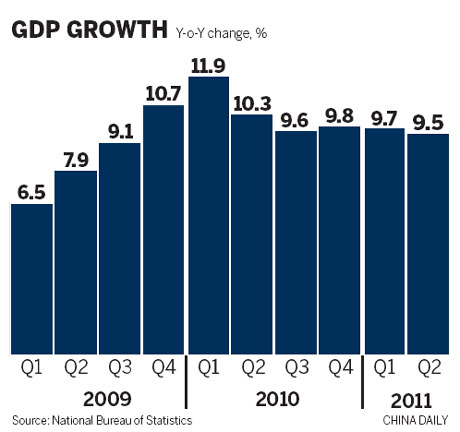 |
Gross domestic product (GDP) rose 9.7 percent year-on-year in the first quarter and 9.8 percent in the fourth quarter of last year.
The figure for the first half of this year stood at 9.6 percent.
"China's economy maintained steady and fast growth in the first half of 2011, strongly supported by the expansion of fixed asset investments, domestic consumption and exports," Sheng Laiyun, a spokesman for the National Bureau of Statistics (NBS), said on Wednesday.
Industrial output in June increased 15.1 percent from a year earlier, from 13.3 percent in May. The month-on-month growth rate was 1.48 percent, according to the NBS.
Fixed asset investments rose 25.6 percent by the end of June from a year earlier, compared with 25 percent in the first quarter, easing market concerns about an investment slowdown.
"Industrialization and urbanization will keep GDP growth on the fast track," Sheng said.
Inflation remains a major risk for the economy, and monetary policy may be adjusted accordingly in the second half, economists said.
The consumer price index (CPI), a key inflation gauge, rose 6.4 percent in June, recording a three-year high.
Premier Wen Jiabao said on Tuesday that maintaining price stability remains the top priority, and the government will stick to macro-control policies.
However, Wen added that "policies will be responsive, preemptive, and flexible to changing conditions".
Policymakers want to tackle inflation without stalling the economy, analysts said.
"(Wen's) remarks indicate that policymakers want to fight inflation and reposition for any downside risk in growth," Yao Wei, China economist with Societe Generale, said.
The central bank has raised benchmark interest rates three times this year, to soak up liquidity, and hiked the reserve requirement ratio for banks, the amount they have to set aside, six times during this period.
"Interest rate increases will affect China's economy in the near term, but in the long run they will boost sustainable development," Sheng said. "Price stability will be a priority during the rest of the year."
Inflation is expected to ease in the coming months as food prices drop due to the harvesting of summer crops, Sheng said.
On Wednesday, the State Council also promised the government would take measures to promote the development of the live pig industry to bring down prices, including providing subsidies to farmers.
The decline of global commodity prices in June is expected to reduce imported inflationary pressure, Sheng said.
"We expect inflation to remain within the 5 to 6 percent range in the third quarter, before declining to around 4 percent by the end of the year," Stephen Schwartz, an economist with Spanish bank BBVA, said. He expected one more rate hike and another 50 basis points increase in the required reserve ratio over the next six months.
"We are looking for less frequent monetary tightening," Yao Wei said.
Chang Jian, an economist with Barclays Capital, said that the probability of "over tightening" is small.
"We continue to believe slower growth is needed to keep inflation under control and expect year-on-year growth to slow to 8.7 percent in the fourth quarter," Chang said.
He estimated growth for 2012 at 8.7 percent, compared to 9.3 percent in 2011.
According to Chang, outside risks to the economy have increased in recent weeks, with disappointing US data and European GDP forecasts.
According to Duncan Freeman, senior researcher with the Brussels Institute of Contemporary China Studies, the European downturn will hurt China's exports as consumer spending will be curtailed.
Fu Jing in Brussels contributed to this story.