The challenges of company succession
Updated: 2011-07-12 09:34
By Karen Yip (China Daily)
|
|||||||||||


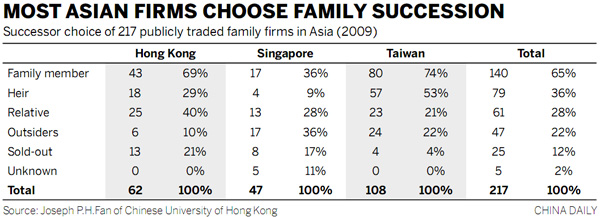 |
In a joint study conducted on 250 companies controlled by Chinese families in Hong Kong, Taiwan and Singapore, Joseph Fan, a professor at the Chinese University of Hong Kong found that successions tended to go along with major declines in the stock value of these listed companies.
"If you hold shares valued at 100 yuan ($15) five years before the succession, the value will drop to 40 yuan by the time the company announces a succession," he said.
"It's a very challenging task. Most Asian companies have not done well. Those that have done well took 15 years to plan a succession," Fan said.
More than planning, succession requires founders to look deep at their lives and families too. "How many times they return home to eat, how many mistresses and children out of wedlock they have all these matter," he said.
Even if succession is well planned, the ferocity of the business environment in China posed extra challenges to companies, he said.
A change in local government officials, unforeseen recession or macroeconomic changes, or starting the succession in a hostile business environment can find companies unable to turn against the tide.
When Party member Lou Zhongfu first built Dongyang-based Zhejiang Guangsha Co Ltd in the 1970s into the multi-industry group it is today, he had the foresight to show his two sons the ropes in the hope that they could take over from him when he retires.
However, the listed Zhejiang Guangsha Co Ltd performed poorly over the years, which were predominantly affected by uncontrollable events. When the Dongyang local government changed hands in 2001, 2005 and 2007, even the well-connected Lou had to rebuild 'guanxi' several times over while watching the company's debt rise due to various outstanding infrastructure projects.
Since 1993, Guangsha Group has invested 400 million yuan in the construction of infrastructure such as Dongyang Children's Park, Xishan Park, Guangsha Baiyun Culture City and Tiandu City Huanle All Season Park.
The listed company performed poorly in the stock market over the years and reported losses of 177 million yuan in 2005 and 272 million yuan in 2006. In the same year, the company found itself embroiled in credit scandals over defaults involving large loans.
In 2010, the listed Zhejiang Guangsa started to install a new set of board members and is expecting to turn the corner, backed by an experienced team.
Fan expects fights for control of Chinese mainland companies to be more severe than their other Asian counterparts due to a vacuum in values in current Chinese society.
"We used to say family businesses tend to survive up to the third generation. With poor family governance, businesses in China can only last one generation," he predicted.
He predicts that most of the Chinese entrepreneurs may sell their businesses before retirement and transfer their capital out of the country.
"It's very unfortunate if this were to happen. You can sell assets but not brains. Intellect could not be passed down to the next generation," he said.
In addition, the one child in most Chinese families mean that it will be tough going for entrepreneurs to pass on to family members.
It's understandable that most founders of businesses in Asia and Europe desire to keep them within their families and partly also because of fear of betrayal.
The boardroom battle for control of Gome Electronics is a perfect example of an outsider hired as a professional to run the business who tried to seize control from founder Huang Guangyu, Fan said.
It's not surprising that most founders of companies believe that blood runs thicker than water.
Huawei's President Ren Zhengfei had almost similar experiences too. He promoted Li Yinan, a bright young executive, to be his second in command and potential successor. However, Li left Huawei in 2000 to start a rival company, which was later bought by Huawei in 2006.
For the first time, Huawei began disclosing biographies of its board directors in the group's 2010 annual report in order to be more transparent and "adopt a market-oriented corporate governance structure as part of its growth strategy".
While companies can outlive their founders, founders cannot live for centuries.