Energy
Lighting way for solar power
By Tang Zhihao (China Daily)
Updated: 2011-07-07 15:14
 |
Large Medium Small |
|
 |
|
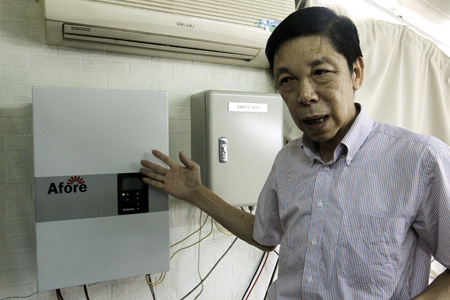
After five years of successful operation, Zhao Chunjiang, an advocate of green energy, says he hopes his solar generator can serve as an example for others to follow. [Photo / China Daily] |
SHANGHAI - Zhao Chunjiang's dream is that one day every rooftop in this eastern metropolis will have a solar power generator.
Although he admits that day is still a way off, as the director of Shanghai University of Electric Power's solar energy institute he hopes to lead by example.
| ||||


"I'm an expert and an advocate for solar energy," he said. "There were times when I tried to persuade people the technology is practical and they responded by asking why, if I was so sure, I hadn't built my own system."
So he did. He moved out from the city center and bought a rooftop property in the outlying Minhang district.
Zhao has spent about 122,000 yuan ($18,800) on his mini power plant, including the cost of the solar panels that cover a total area of 21 square meters. Based on the current electricity prices, however, it will take Zhao roughly 60 years to break even on the investment.
Being located in Shanghai also posed challenges, especially when it comes to the weather in East China.
"There are frequent typhoons in the summer, so I had to fasten the panels tightly to the roof so that they won't blow off," he said, before pointing to his system and proudly adding: "You see, they've remained safe and sound all these years."
The one problem Zhao could not solve by himself was calculating the electricity he exports, as the ammeter installed by the power company does not separate power produced by his home generator from that provided by the State Grid Corporation.
The expert initially had to pay for whatever went through the ammeter, including his exported electricity. Yet, in April this year the power company installed another ammeter to calculate the power he generates.
"The company asked me to set a price for my electricity, but as an ordinary citizen I don't think I can," he said, explaining that in countries like Japan and Germany, power firms pay as much as five times the price for electricity retrieved from green home generators. "It is a national effort to encourage the development of green energy."
Despite his optimism, Zhao admits he feels China still has some way to go when it comes to promoting solar energy. For example, he said, in 2004 it was reported that the Shanghai government was planning to install solar panels on the roofs of 100,000 families' homes.
"It seems I was the only one who really took it seriously," Zhao said with a smile. "Of course, mine is only an experiment. My target is to gather some data to see whether the idea can be promoted in Shanghai."
The grid serving China's financial powerhouse does not have the capacity to meet peak demand in the summer, with rationing coming into force whenever the mercury hits 37 C, which is often.
Some 24,000 businesses, mainly factories and other industrial plants, will face mandatory power cuts, while this year 3,000 non-industrial businesses - shopping malls and office blocks - will also be asked to close their doors to guarantee household demand, according to media reports.
Zhao said that, based on his observations, the full use of solar power in Shanghai could satisfy one-third of residents' power demands. To make it happen, though, the government needs to be in support.
"The initial investment for a set of panels is about 60,000 yuan, so it's very important to provide subsidies for residents. There also needs to be a repurchase scheme for power exported to the State Grid," Zhao said. "Neither of these are there yet."
"The biggest obstacle comes from power providers. The law stipulates that power companies need to purchase solar power, but enforcement has been poor," he added.
Without financial support from the government and power companies, Zhao said it will be hard to make his dream come true. "It takes about 30 years for a solar power generator plant that costs 60,000 yuan to pay for itself," he said. "That may be too long for ordinary people to wait."
?
| 分享按鈕 |