Companies
Unilever raises product prices, news report says
By Wang Ying (China Daily)
Updated: 2011-05-26 11:09
 |
Large Medium Small |
|
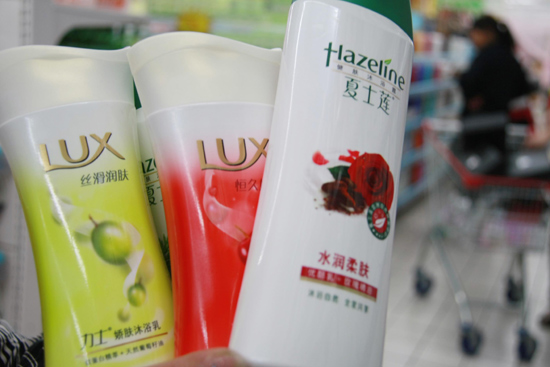 More than one retailer in Guangzhou said they received notice that Unilever PLC will raise the price of their Lux and Hazeline products starting on Tuesday. [Photo / Provided to China Daily] |
SHANGHAI - Unilever PLC, the world's second-largest consumer goods maker by capitalization, after Procter & Gamble Co, reportedly starting raising the prices of some of its Hazeline and Lux brand products in Guangzhou, Guangdong province, on Tuesday.
That's less than three weeks after being fined 2 million yuan ($308,000) by the National Development and Reform Commission (NDRC) for releasing misleading information that consumer-good prices would surge.
More than one retailer in Guangzhou said they received a notice that Unilever's Hazeline and Lux sub-brands were raising their prices starting on Tuesday, Guangzhou Daily reported on Wednesday. Some of the product prices increased as much as 10 percent.
"We are not allowed to make any comment on our product prices," Zhu Jianwei, an employee at Unilever's communications department in Shanghai, told China Daily.
|
||||


"We have seen the government try everything to prevent consumer good prices from increasing. In Unilever's case, the NDRC talked with it and persuaded it to abandon its decision to raise prices, and it even imposed a 2 million yuan fine. But the company seems not to have learned from the fine," Qi said.
"Though its price increases don't violate Chinese law, consumers can choose how to react to them. For example by changing brands in a fully competitive market," Qi added.
Zhang Jun, a professor specializing in Chinese economic studies at Fudan University, sees the matter differently.
"Traditionally, consumer goods manufacturers have no motive to raise prices because that usually means a loss of customers, who have less brand loyalty and are more sensitive to cost. I think they are doing it because they are forced by the pressure of rising costs," Zhang said.
"That's why Unilever claimed it would raise product prices earlier this year, hoping the whole industry would act in unison to avoid boycotting," Zhang said. "Unfortunately, such a maneuver only brings a fine from the government," he said.
Since the government closely watches consumer product prices, other companies will not follow suit. But it is highly likely that they will decrease the content of their products instead in order to cushion the cost pressure, Zhang added.
On May 6, the NDRC announced on its website that after a joint investigation with the Shanghai Price Bureau, it had decided to penalize the British-Dutch multinational Unilever for illegally signaling that the prices of consumer goods would be raised.
The NDRC carried out investigations in several Chinese cities' during shopping rushes for household items in late March, and correlated these incidents with speeches made in late March by Zeng Xiwen, vice-president of Unilever China, who suggested price hikes of consumer products were in store because of the soaring cost of raw materials.
Unilever's shampoo, skincare and laundry detergent products held 12 percent to 15 percent of domestic market share. Consequently, signaling the probability of price rises was highly likely to lead to an industry-wide price hike, according to the NDRC's announcement.
The NDRC and Shanghai Price Bureau jointly fined Unilever 2 million yuan, the May 6 announcement said.
"We accept the decision of the NDRC and Shanghai Price Bureau. As a responsible company, we abide by laws and regulations in China and our global code of business principles. Consumers are our top priority, and we will continue to provide high quality products to the public," Unilever responded in a public notice the same day.
"If Unilever were to raise its prices, I could buy P&G or others," said a consumer named Jin Guo. "But I would rather companies raise the price openly than quietly reduce the volume of shampoo. In this case, I think Unilever is more honest," said Jin.
Retailers interviewed by China Daily in Shanghai have not yet received notice of price increases.
| 分享按鈕 |