InfoGraphic
Production battles against the dark ages
By Wang Zhenghua and Wu Yiyao (China Daily)
Updated: 2011-05-10 11:09
 |
Large Medium Small |
Reliance on coal
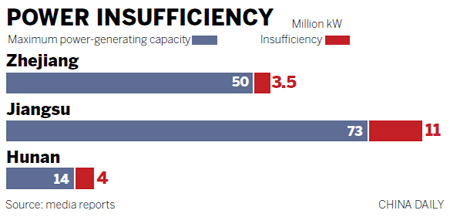
The rising cost of coal, the largest source of power generation in China, has discouraged many power plants to increase their capacity to produce thermal power this year, while plants ran short of ways to raise the price of electricity, which is administered tightly by governments.
China relies heavily on coal for electricity production. More than 80 percent of power is generated by the fossil fuel. In the first quarter alone, 323.2 billion kW out of 383 billion kW - 84 percent - were generated from coal in China, according to the China Electricity Council.


The unwillingness of power plants to increase capacity pointed to the jump of coal prices. The average price of domestically produced coal reached 773 yuan a ton by the end of March from around 700 yuan in previous months. The price at major production sites, such as Shanxi and Inner Mongolia, has risen by double digits since earlier this year.
Fuel imports, on the other hand, declined in the first quarter year-on-year, according to the National Energy Administration. For instance, the floods in Australia early this year pushed up the price of Australian coal on international markets. In the first quarter of 2011, China imported 32.37 million tons of coal, a 26.4 percent year-on-year decrease.
Under the circumstances, the stock of coal at major power plants shrank quickly - to 53.1 million tons in April, sufficient for only 14 days, lower than the nation's warning level of 15 days.
Some captive power plants, those operated by big companies for their own use, simply suspended their production, increasing the pressure on public grid.
"For many power plants, the more electricity they produce, the more severe financial losses they will face," said Xue Jing, director of the Electricity Council's statistics department. "Power plants in China have been suffering from a short supply of coal for several years, and it reached a peak in 2011."
In the meantime, the low water levels for hydropower generation worsened the power crunch in the country.
| 分享按鈕 |