Companies
Electrical appliance vendors seek the best way to survive
By Tang Zhihao (China Daily)
Updated: 2011-03-21 09:57
 |
Large Medium Small |
BEIJING - Despite the closure of the United States-based Best Buy Co Inc's branded-stores in China, multinational companies are keeping a close eye on the electrical appliances and electronic products retailing business in China amid aspirations to open more stores to cash in on the booming market.
According to China Market Monitor, a Beijing-based consulting firm that specializes in the retailing business, the total sales of electrical appliances and electronic products was 1.04 trillion yuan ($158 billion) in China last year, an increase of 45 percent from 2006.
Germany-based Media Markt has set up two branded stores in Shanghai. Yamada Denki Co Ltd of Japan opened a Shenyang store in 2010 and is expected to open another store in Tianjin in June.
|
 |
|
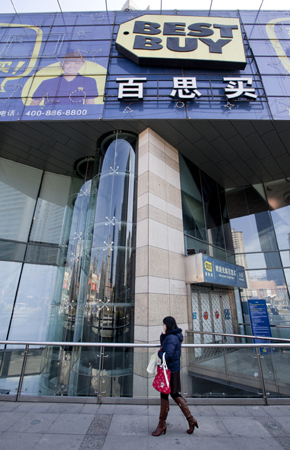
A pedestrian outside a closed Best Buy Co Inc store in Shanghai. Best Buy, one of the world's largest consumer electronics retailers, is closing its nine Best Buy-branded stores in China and two in Turkey and restructuring operations in those markets. [Photo / Bloomberg] |
Media Markt said it planned to open some 100 branded stores around China over the next five years to support its global expansion.
However, the closure of Best Buy's Shanghai headquarters, along with its nine Best Buy-branded stores in China, has suggested that expansion by multinational companies in China might not run as smoothly as they anticipated.
Best Buy, which has 19 percent of the US market for electronic products, entered China five years ago and was running some 170 stores in the country under its Best Buy and Five Star Appliance brands by the end of 2010. In comparison with Chinese rivals such as Suning and Gome, industry experts say Best Buy's expansion in China was too slow.
Experts said Best Buy's customer-centric strategy did not help to distinguish the company from local rivals. The operating strategy, which was not well recognized by suppliers and customers, is said to have constrained the company's expansion in China.
"The purchasing volume was not attractive to suppliers and the price offered was not low enough to attract customers," said Chen Can, a senior analyst from Analysys International. "Best Buy brought in a Western business model but it failed to sufficiently attract Chinese clients and customers to it."
Industry insiders said Best Buy was operating like a boutique store in China in the hope customers would perceive the value behind the brand and pay a premium price for products. However, this was often disregarded by customers in favor of price.
Best Buy's targeted profit margin was about 15 percent, while the profit margin for local retailers remains about 5 percent, according to Chen.
Wang Jian, the newly appointed vice-president of Best Buy in China, was quoted by Shanghai Oriental Morning Post as saying that Best Buy's high operating costs and high profit margin was not appropriate in China as consumers still prefer to purchase discounted products.
In addition, experts said Best Buy failed to establish brand identity among Chinese consumers. In cities other than Beijing and Shanghai, the company's profile was practically non-existent.
"Best Buy is a global retail brand and a particularly formidable force in its domestic US market. It was relatively unheard of in China prior to its acquisition of Jiangsu Five Star Appliance Co Ltd. This meant that it had to invest a considerable amount of capital just to achieve local brand recognition," said Lamine Lahouasnia, a retail analyst from Euromonitor International.
Zhou Qun, sales and marketing director from GfK Retail and Technology China Co Ltd, said the difficulties suffered by Best Buy are commonly seen among international companies.
"Best Buy has provided a good case-study for foreign companies," said Zhou.
Absorbing the lessons from Best Buy's failure, Media Markt and Yamada Denki have taken more cautious approaches to strengthen their positions in China.
| ||||


"Each store has its own pricing team. They need to observe local prices on a daily basis so they can adjust their prices according to what they see in the neighborhood to offer customers the lowest price," said Ton Wortel, chief executive officer of Media Markt China.
Yamada Denki chose to develop in the cities where competition is not as intensive as it is in Shanghai and Beijing.
"Yamada has taken a more cautious approach by choosing a local market with a significant Japanese and South Korean expatriate community. Fewer domestic competitors will also mean that Yamada Denki should be able to grow into a regional retail force," said Lahouasnia from Euromonitor.
Zhou said there must be some foreign companies willing to expand in China that will take a different approach from Best Buy and will not run the store like a boutique.
"The firm may concentrate on a narrow segment where local rivals have a weak position - for instance, the digital products sector," said Zhou, "Foreign companies have a strong presence in American and European countries so they can capture demand from young consumers very quickly. They have an advantage that cannot be achieved by domestic retailers."
| 分享按鈕 |