Economy
Inflation, prices top list of public concerns
By Chen Jia (China Daily)
Updated: 2010-12-16 11:10
 |
Large Medium Small |
BEIJING - High inflation and soaring housing prices have contributed to growing public dissatisfaction with their quality of life, the country's top think tank said on Wednesday.
Job satisfaction for urban residents, and confidence in social welfare programs, dipped to their lowest levels since 2006, according to the 2011 Blue Book of China's Society released by the Chinese Academy of Social Sciences (CASS).
The findings for urban residents were mirrored in their rural counterparts, with job satisfaction, concerns over the economy and social welfare at their worst in four years, according to the survey.
The survey, conducted by the Horizon Research Consultancy Group in October 2010, polled 4,143 people in seven mainland cities, as well as seven small towns and rural areas.
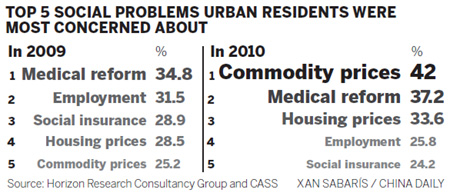
Commodity prices leapfrogged from fifth place in 2009 to be the main concern of urban residents in 2010, followed by healthcare and housing prices.
Again, rural residents had similar concerns, with commodity prices second to healthcare.
Confidence levels of both urban and rural residents in governance, in terms of economic issues and social affairs, dropped from last year, the report said.
In another sign of growing public concern over inflation, the number of citizens satisfied with current price levels has sunk to an 11-year low, the People's Bank of China (PBOC), the central bank, said on Wednesday.
The bank conducted a survey of 20,000 people during the fourth quarter in 50 cities across the mainland.
The Residents' Price Satisfaction Index fell to 13.8 percent - the lowest since 1999, when the quarterly survey began - according to a statement published on the PBOC website.
Some 73.9 percent of respondents said current prices are "too high", up 15.6 percentage points from the third quarter, while 61.4 percent said they expect prices to continue to rise in the next quarter.
China's consumer price index (CPI), a major gauge of inflation, hit a 28-month high of 5.1 percent year-on-year in November, the National Bureau of Statistics (NBS) said on Saturday.
Some 75.5 percent of respondents said property prices are too high, the highest rate since the central bank included them in the survey in 2009.
Some 43.3 percent of respondents said property prices will continue to rise, up 6.8 percentage points from a quarter earlier.
| ||||


"The cautious consumer sentiment reveals Chinese residents are not optimistic about future price levels, which is not conducive to consumption expansion," the PBOC report said.
"Life is no longer bling bling for me this year as commodity prices outpaced my salary," Sha Ying, an editor with a Beijing-based fashion magazine, said. "I haven't gone out shopping for brand dresses for months."
Xu Guangyi, a retiree in downtown Beijing, said he has to buy food and vegetables in a shabby market instead of supermarkets near his home to save money.
Data from the Ministry of Commerce showed the price of 18 types of vegetables, including cabbages, potatoes and cucumbers, rose 62.4 percent year-on-year in early November, while garlic prices rose 95.9 percent, and ginger 89.5 percent, during the same period.
The CASS book said the majority of urban residents expect the government to curb property prices.
The country's real estate bubble has swollen in urban areas, and many cities have a yawning gap between market price and actual value, according to a survey published in a report on the housing market in China (2010-2011) released by the Social Sciences Academic Press last week.
Chen Guangjin, a CASS sociologist, said rural residents are less satisfied with their quality of life than urban counterparts because of poor welfare and public services in rural areas.
The sociologist warned that the widening gap deserves attention as it may "aggravate social conflict and damage social harmony and stability".