Economy
Pollution reduction on target
By Li Jing (China Daily)
Updated: 2010-09-19 11:32
 |
Large Medium Small |
|
 |
|
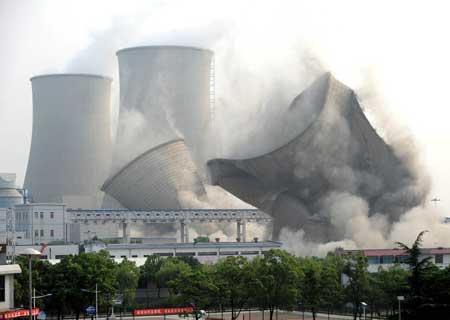
Two 90-m-high cooling towers collapse following a controlled explosion at the Huaneng Changxing Power Plant in Changxing county, Zhejiang province, on Thursday. The plant shut down two outdated electric generating sets in order to reduce coal consumption and waste emission in August. Xu Yu / Xinhua |
On the back of that success, the country will include two more pollutants into its compulsory emission control program during the 12th Five-Year Plan (2011 - 15) period.
"China has dramatically boosted its pollution prevention capacity, and is set to meet the emission reductions of sulfur dioxide and chemical oxygen demand between 2005 and 2010," Zhou was quoted as saying on Friday by People's Daily at an international forum on environment and development.
Sulfur dioxide is a major indicator of air pollution and chemical oxygen demand is a measurement used to determine the level of water pollution.
By the end of last year, the emission levels of sulfur dioxide had fallen 9.6 percent from 2005 levels, while chemical oxygen demand had fallen 13.1 percent during the same period.
That puts China on target to hit its goal of reducing both by 10 percent from 2005 levels by the end of 2010.
In the first half of this year, chemical oxygen demand dropped 2.3 percent year-on-year, but sulfur dioxide levels increased 0.22 percent, according to the Ministry of Environmental Protection.
New goals for nitrogen oxides, which cause acid rain and haze, and ammonia nitrogen, which leads to excessive food sources for bacteria in water bodies, will be included in the pollution control program for next five years, said Zhou.
But detailed reduction targets are yet to be worked out, experts familiar with the matter told China Daily on Friday.
Coal-fired power plants are major sources for nitrogen oxides, which contribute 45.5 percent to total emissions, according to Yang Jintian, deputy chief engineer of the Chinese Academy of Environmental Planning.
Official figures from the Ministry of Environmental Protection show that the country's total emissions of nitrogen oxide reached 20 million tons in 2008, the largest in the world.
Nitrogen oxides, when mixed with other air pollutants, can cause chemical reactions that form haze and smog.
"It is impossible to cure haze and acid rain problems in big cities without addressing pollution of nitrogen oxide," said Yang.
The accumulation of ammonia nitrogen in rivers and lakes can lead to excessive nutrition levels in water bodies - which cause the overgrowth of blue and green algae.
"Under certain conditions, ammonia nitrogen can also convert into toxic compounds, which pose threats to drinking water safety," said Fu Qing, an associate professor with Chinese Research Academy of Environmental Sciences.
| |||||||



China discharged 1.23 million tons of ammonia nitrogen in 2009, with 78 percent being from domestic sewage, according to the Ministry of Environmental Protection.
The country will seek to bolster its rapid economic growth with a minimum of environmental degradation and strike a balance between development and conservation, Zhou told the forum held in Beijing.
He said China needs to improve its green economic policies to facilitate the shift to a "highly effective and low-emission" growth mode.
Between 2006 and 2010, more than 10 billion yuan ($1.5 billion) was put into research and development of technologies related to energy conservation and environmental protection, according to Ministry of Science and Technology.