Companies
7% of SME assets spent on 'relationships'
By Karen Yip (China Daily)
Updated: 2010-07-29 10:30
 |
Large Medium Small |
|
 |
|
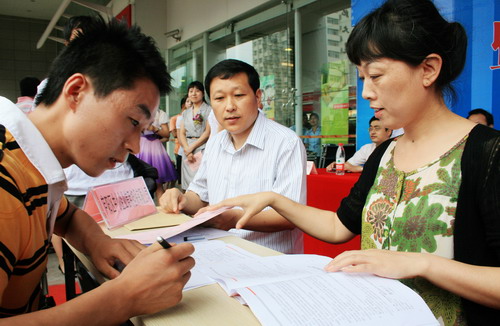
An entrepreneur (left) applies for a micro loan in Hefei, Anhui province. [Ge Chuanhong / For China Daily] |
Small- and medium-sized enterprises (SMEs) in China spent almost 7 percent of total assets on entertaining their key business contacts to develop "social capital".
Findings by the Globalization and Economic Policy Centre at University of Nottingham highlighted the continuing importance of guanxi - or informal networking - commonly practiced among Chinese businesses.
Continued discrimination by banks and a business environment that still heavily favors State-owned enterprises have made splashing out on entertainment vital to the survival of many SMEs, the report said.
The study examined data from annual accounting reports filed with the National Bureau of Statistics by 65,551 firms from 2000 to 2006. Entertainment expenditure, which was used as a proxy for social capital, was found to account for an average of 6.7 percent of firms' total assets.
"Guanxi is an important commercial criteria for SMEs to gain leverage. Wining and dining provides a forum for them to build relationships especially with banks," said Alex Newman, who co-authored the study with Alessandra Guariglia and Jun Du.
Guariglia is professor of financial economics and head of the Department of Economics, Accounting and Finance at Durham Business School. Du is a lecturer in economics at Aston Business School.
| ||||


"Informal financing isn't necessarily appropriate if China wants to develop world-class private firms than can compete globally," said Newman.
"A generous expense account can only get you so far, and in the long term policymakers need to improve access to bank financing."
Newman, a lecturer in international business at Nottingham University Business School in Ningbo, described the amount of entertainment expenditure as "significant".
"Until 1998, when the constitution was changed, State-owned commercial banks were instructed to lend only to State-owned enterprises.
"Even now banks still consider private enterprises riskier than their public-owned counterparts - and the problem is even bigger for SMEs," he said.
The study concluded that for many SMEs, social capital effectively acts as a substitute for fixed assets as security for short-term lending. By contrast, firms able to access long-term financing generally have less need to splash out on meals, gifts and other expenses.
Co-author Guariglia said,"without adequate social capital, SMEs may face huge difficulties in obtaining the short-term financing so vital for them to survive their early years."