Economy
'Made in China' - but for how long?
By Andrew Moody (China Daily)
Updated: 2010-07-19 09:22
 |
Large Medium Small |
Alistair Thornton, an analyst with IHS Global Insight, said it was difficult to interpret what was happening to China's manufacturing sector.
He said one likely explanation was that China had reached the so-called "Lewis Turning Point" (named after the British economist Arthur Lewis) at which an economy reaches a point in its development when it exhausts its supply of rural migrant workers, thus putting pressure on wages.
"Another explanation is that we are seeing the effects of the stimulus package which has created jobs in infrastructure development in western and central China, reducing the pool of labor for manufacturing. It is not likely to be one or the other but a combination of both," he said.
What the Chinese government would like to happen over the medium term would be for the coastal regions to become centers of manufacturing excellence while low-tech manufacturing moves inland.
If some Chinese or foreign companies decide to switch manufacturing to Southeast Asian countries, the economic damage need not be that great.
During this process, however, China still needs to retain a sizeable labor-intensive manufacturing sector because its unusually large population is always hungry for jobs.
Thun added China could not get into a game of chasing ever lower labor costs because this would be ultimately self-defeating.
"The only way labor costs are going to be kept low is if development doesn't succeed. Development inevitably is going to raise your costs," he added.
"It is nonetheless a dilemma for the government. From an employment perspective they still need low-end manufacturing but, on the other hand, the fact that labor costs are rising is to some extent a sign of success."
Jim Pinto, an expert in automation based in San Diego, California, who predicts future trends in manufacturing, said China's manufacturing sector was likely to prove more resilient than many realize.
"Labor is not the big element to manufacturing costs many people think. A lot of manufacturing is relatively automated. What distinguishes China is the low margins its companies can survive on," he said.
"China can make an iPhone for $200 and sell it to Apple for $220, whereas a European maker, for example, would sell it for $360. The availability of cheap loans and tax holidays means it can survive on these lower margins."
Dr Stephen Dyer, principal in management consultants AT Kearney's Shanghai office, said it was too easy to see manufacturing being about labor rates.
He pointed to a project his firm undertook for a US furniture maker. It showed wage rates in China were 17 times less than at its factory in America. When higher US labor productivity was taken into account, the difference in labor cost was just five times. The labor content of any finished item of furniture was between 5 to 10 per cent.
"An increase in labor rates in this case would only have a small impact on margins," he said.
"You cannot disregard it, however. The automotive industry survives on 2.5 per cent margins and any increase in cost could make a sizeable dent on these."
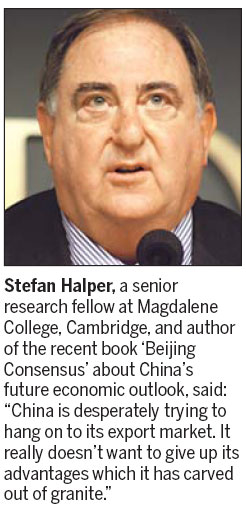
Dr Stefan Halper, a senior research fellow at Magdalene College, Cambridge, and author of the recent book 'Beijing Consensus' about China's future economic outlook, said recent events put China's manufacturers at some form of crossroads.
"China is desperately trying to hang on to its export market. It really doesn't want to give up its advantages which it has carved out of granite," he said.
He said attempts to cling on to its manufacturing prowess by making some of its goods offshore in Southeast Asia and then re-exporting them from China carried risks.
"They are going to find themselves in the same situation as American manufacturers, which will add a new interesting dimension to the globalization process. They will not win friends in the countries they site their new factories if they also export the worst conditions of China factories," he added.
Dr Dyer at A T Kearney said this constant seeking of some form of labor arbitrage would not work for China or any other country in the long term.
"This idea that Vietnam is the next Shangri-La and that we can keep on moving production to the lowest cost place is not really the future of manufacturing. In theory there will be eventually nowhere lower cost to move and costs will be equal everywhere, although I doubt that will be the case in reality," he said.
He predicts manufacturing would take place in future in the markets where the goods were intended to be sold.
"In the automotive industry product development is the most important part of the process. All the components can be manufactured and assembled in the relevant markets. There would be differences in the way this was done between India and China, for example, and cost differences, but it wouldn't be about chasing labor rates," he added.
|
||||


"It is said that by doing this you are moving further away from transport links and supply networks. It happened in the 1980s in Shanghai as a lot of development quickly pushed out to Zhejiang. It will be an incremental process. It may not go as far as the deepest western provinces but it inevitably pushes back from the coastal areas," he said.
It is in these coastal areas such as Guangdong where Chinese manufacturing is facing its biggest test, perhaps since reform and opening up began in the late 1970s.
Pinto, the manufacturing futurologist, said China was not about to lose its crown as the world's workshop overnight.
"China has really learnt how to ramp up manufacturing. It can provide quantity and quality at speed and this gives it real advantages over many other countries. It is not going to lose that any time soon," he said.