Economy
Roubini insists he's no doomsday pundit
By Li Xing and Ding Qingfen (China Daily)
Updated: 2010-06-24 09:34
 |
Large Medium Small |
Nouriel Roubini Professor,New York University
Economist says China, India, Brazil are bright spots of global recovery
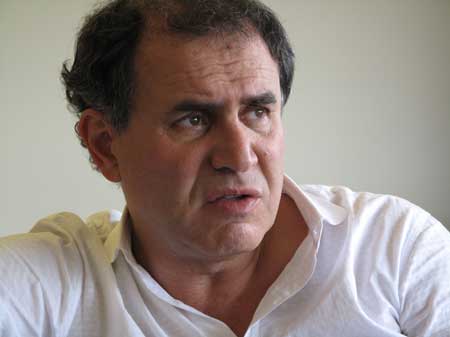
New York - Dr Doom is not a happy man these days with what is happening across the globe.
Noted economist Nouriel Roubini, who earned the sobriquet "Dr Doom" after correctly predicting the subprime mortgage meltdown in the United States and the subsequent financial crisis, feels that uncertainties will hamper global growth.
Roubini, who also teaches economics at New York University, had in 2006 warned of the inherent risks in the US banking system and said several financial institutions were tottering on the edge of the precipice. He was proved right when big financial institutions like Fannie Mae and Freddie Mac collapsed in 2008.
But Roubini insists that he is not a doomsday pundit.
"I would rather be called a 'Dr Realist', who is neither pessimistic nor optimistic, but someone who wants to be right and tries to figure out the upside of the risk," he said in an exclusive interview with China Daily.
Much of the present day problems are due to the sovereign debt crisis in the eurozone, high unemployment rate in the US, stagnation in Japan and other issues like bubbles in the property market and labor unrest in China.
While the problems persist, there also exists the need to come out with lasting solutions to prevent the economy from going into a double-dip recession.
Roubini feels that this would be the main challenge for the leaders of the developed nations at the forthcoming G20 meeting in Toronto.
The leaders will also have to come up with solutions for maintaining sustained economic growth, he said.
Explaining his point, Roubini said the recovery would be anemic and U-shaped rather than the expected V-shaped in advanced countries.
He doesn't have good news for the US either. Growth in the US will remain weak in the first half of the year at around 3 percent, much lower than the earlier anticipated 5 to 6 percent, he said.
Painting a grim picture, Roubini said the second-half figures could dip below 2 percent, further compounding the problems.
At the same time, he doesn't see comfort zones coming up in the eurozone and Japan, as recovery in these regions is still far from promising.
The real bright spots of recovery have been in emerging markets like China, India, Brazil, as well as some Asian and Latin American countries.
"It is important to sustain economic growth globally, as lower growth will only make things worse," he said.
"Unemployment will be higher, social tensions will be higher, budget deficits will be higher, losses on assets' bubbles will be bigger," he said.
Roubini feels that the right prescription is a rebalancing of the global economy. Countries like Germany, Japan, China and other emerging Asian economies should spend more, export less and sustain growth by boosting domestic consumption.
He said the US and others like the United Kingdom, Spain, Ireland, Iceland and New Zealand were the big consumers in the past. But these nations ended up spending more than their income and rang up huge current account deficits.
At the same time the predominant producers like China, emerging Asia, Japan and Germany - countries that spend less than their income - were running up huge current account surpluses.
"China and other countries are right in telling countries like the US that they need to cut budget deficits," he said.
"Last year most of the governments reacted aggressively with monetary stimulus and stopped the global economy from a free fall. But the G20 nations clearly have priorities that are different from one another," he said.
"The asymmetry implies that global economic recovery is weaker than expected," Roubini said.
| ||||


"I am not blaming the US, or China, but everyone should do their part," said Roubini.
Criticizing the German government's recent austerity plan, he said it is "mistaken in several dimensions".
Growth is the main concern in Europe. Many countries like Greece, Spain, Portugal, Italy and others have huge budget deficits that need to be reduced. So there is the danger of deflation and recession in the eurozone.
Nations that are planning austerity measures must also come up with easier monetary policies to sustain economic momentum, he said. At the same time, the euro has to depreciate gradually and progressively, he said.
"Germany has to think about the economy of the eurozone, cut taxes and raise wages to boost consumption and purchasing power," he said. "Instead of introducing fiscal austerity now, they (the Germans), can wait for two or three years."