Economy
Resource tax revamp soon
By Wang Xiaotian (China Daily)
Updated: 2010-05-21 09:06
 |
Large Medium Small |
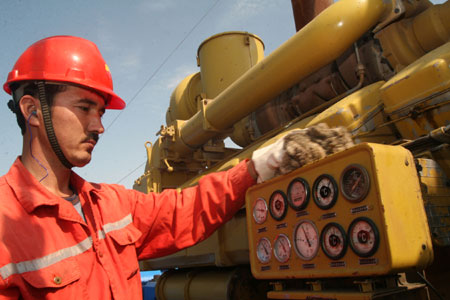
An employee checking meter readings at an oil well in the Xinjiang Uygur autonomous region. [Zhou Jianling / for China Daily]
Trials planned in Xinjiang, other regions before national roll out
BEIJING - China is planning to alter the taxation structure on the profits that companies make from energy products on a trial basis in Xinjiang, participants at the Xinjiang work conference said on Thursday.
The conference has suggested that the prices of resource products should be taken into consideration when levying the taxes, rather than the existing system that takes into account the actual output.
There were no indications as to what the tax rate would be. Analysts are, however, of the view that it may be 3-5 percent for resource products like oil.
It may still be two to three years before the government would be able to implement the reforms nationally, said Lin Boqiang, director of the Energy Economics Research Center at Xiamen University.
Some analysts, however, expect the new reforms to be rolled out next year.
Although no detailed time frame is available, officials and analysts said the reforms would focus on increasing the tax rate and expand the scope of products it covers from oil and gas to broader areas like minerals, land, plants and water.
"All these moves are likely to be tested out during the pilot program that would be implemented in other areas later," said Lin.
The government may include one or two more inland areas rich in resources, such as Shanxi province and the Inner Mongolia autonomous region in the pilot plans at a later stage, he said.
Xinjiang has been selected for the pilot program as most of the resources in the region are yet to be explored, said Lin.
The country has been considering a revamp of the resource tax structure for several years to improve the efficiency of natural resource exploitation and also protect the environment.
"This is the best time to take action", said Jia Kang, director of the Institute of Research at the Ministry of Finance, in an earlier interview.
The move, when implemented, may increase the costs of resource products and also lead to price hikes, he said.
The government's plan to revamp the resource tax structure amid rising inflation concerns this year would also help mitigate the possible adverse reactions from future price hikes, said Jia.
| ||||


But not all are convinced.
Some analysts feel that the new system would increase production costs, especially at a time when the economic recovery is still fragile and riddled with uncertainties.
The actual taxation rate could also be problematic, they said.
If the government decides on a 5 percent rate, companies like PetroChina would have to pay at least 33.9 billion yuan ($5 billion) in taxes, subject to oil prices remaining at 5,000 yuan per ton and output at 135.6 million tons, the level of last year.
Lin expects the government to start with a considerably low tax rate and opt for gradual increases later.