Energy
Technology key to keeping cutting edge
By Andrew Moody and Bao Chang (China Daily)
Updated: 2010-04-12 10:11
 |
Large Medium Small |
Billionaire blames small firms' excessive output on reluctance to invest
 |
|
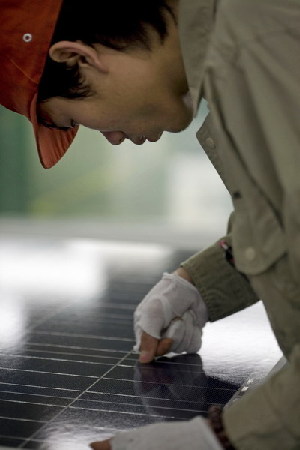
A worker inspects a completed solar panel before packaging at a solar power factory in Wuxi,Jiangsu province. The effective demand for what the photovoltaic industry produces is huge. [Agencies] |
The 34-year-old, who was listed by Forbes magazine as one of the richest 500 men in the world, is chairman and chief executive of one of China's leading new energy companies, LDK Solar.
"Some small companies that lack advanced technology and good quality products have entered the market and it is not good for the industry. They should be forced out of business," he said.
Overcapacity in the solar power industry is a worldwide problem. According to some industry reports nearly half of solar panels produced in 2009 will remain unsold until 2012.
The State Council has highlighted solar power and wind power as industry sectors with crippling overcapacity.
Peng, who is known by his nickname "Light', launched LDK in 1997 and has since floated it on the NASDAQ.
The company employs around 14,000 people in Xinyu, Jiangxi province, which is now known as 'Solar Power City' with a cluster of other similar businesses.
The entrepreneur said there was no overcapacity issue for those who invest in technology and provide high- quality products but just for those who churn out cheap alternatives.
"There's no overcapacity problem for us. Even though we have a 24-hour production cycle, we can't meet all customers' demands," he said.
The financial crisis did result in some delayed orders but this proved short-lived, he added.
"Because of the financial crisis, many foreign solar power projects were delayed, resulting in a temporary difficulty for the photovoltaic industry but it is no longer the case."
Peng maintains, however, that the outlook for the industry remains strong. He believes 60 percent of the world's energy supply will come from solar power in 100 years.
"The effective demand for what the industry produces is huge. Solar power now makes up less than 1 percent of the energy consumption around the world a year. It still takes a long time for solar power to become a substitute for traditional energy. The potential demand for solar power far outweighs the production capacity," he said.
Sun Guangbin, director of China Chamber of Commerce for Import and Export of Machinery and Electric Products, agreed the main problem of overcapacity was with those companies who failed to invest in technology.
He said low-tech products accounted for nearly 60 percent of China's solar energy exports and as a result companies in developed economies reaped the majority of worldwide profits, despite China's apparent market dominance.
"The government and companies should add investment in technologies in order to change the situation, " he said.
| ||||


With funding available a lot of new companies have entered the market.
It is estimated there could be 50 percent more capacity than turbine demand by next year.
Zhou Dadi, former director general of the Energy and Research Institute of the National Development and Reform Commission, the macroeconomic management agency under the State Council, says this industry is being dragged down by a number of low-tech companies.
"Many wind power makers make no effort to enhance technology. They instead buy the technical expertise and licenses from foreign companies just to build capacity," he said.
"This risks this new energy sector being brought into the sort of price competition seen in low valued industries like the manufacture of shoes and toys. It merely sounds better to be involved in new energy rather than these traditional sectors."
Lan Lan contributed to this story