Top Biz News
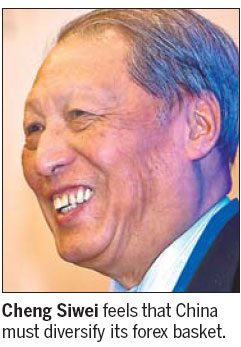
Reduce reliance on US T-bills, says Cheng
By Zhou Yan (China Daily)
Updated: 2010-04-01 09:26
 |
Large Medium Small |
SHANGHAI: China should be cautious in buying or selling huge amounts of US Treasury bonds due to the inherent risks they pose, Cheng Siwei, an influential economist, said on Wednesday, suggesting that the suitable ceiling for the nation's foreign exchange reserves is $800 billion.


The nation's foreign exchange reserves, the world's largest, climbed $453 billion in 2009 to $2.4 trillion. China is also the largest owner of US Treasury securities and held $889 billion of the securities by the end of January this year after scaling it down from $894.8 billion in December 2009.
Yi Gang, head of the State Administration of Foreign Exchange, said in March that the country's diversified allocation for foreign exchange reserves mainly include the US dollar, the euro, and the Japanese yen, without providing the currency composition of the holdings. However, analysts maintain that over 70 percent of the forex reserves are in US dollar-denominated securities.
"We could maintain the scale of forex reserves by increasing the overseas purchasing volumes to slash the trade surplus, and also spur more direct investment abroad," Cheng said.
Talking about the mounting pressure from countries like the United States on yuan appreciation, Cheng said China should keep the yuan exchange rate "basically stable at reasonable levels" but with more flexibility.
"Don't make the valuation of the Chinese currency too political ... the rate fluctuation will directly impact the global trade framework and impede the progress of the global economic recovery," he said.
Cheng said China should tune its foreign exchange policy to market demand without interference from the central bank if the floating exchange rate fluctuates within 3 percent.
"The 3 percent fluctuation is acceptable at current stage We can expand the movement range and types of currency gradually when the government's management level improves, and finally make Chinese yuan a fully convertible currency," Cheng said, without providing any time frame, but adding that the final goal will be achieved "sometime soon".
China ended its currency peg to the US dollar by linking the value of the yuan to a basket of currencies since July 2005, but re-pegged it to the US currency from July 2008 after the global financial crisis.
With regard to China's mounting inflation concerns, Cheng said it would be difficult for the government to achieve the consumer price index (CPI) target of 3 percent this year, as more liquidity would enter the real economy. "5 percent CPI growth in 2010 looks more achievable," he said.
The country posted a higher-than-expected 2.7 percent CPI in February.
China should discuss with the US and Europe about exit strategies, and act in accordance with these nations to avoid the excessive hot money inflows that may fuel domestic inflation, he said.