Opinion
Tipping off polluters
By Hu Yongqi (China Daily)
Updated: 2010-01-13 07:57
 |
Large Medium Small |
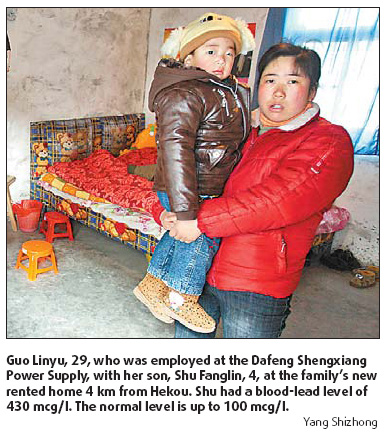
Had they spoken up, however, the recent lead poisoning scandal that has resulted in at least six children being hospitalized may have been avoided, she said.
Guo's 4-year-old son, Shu Fanglin, was one of the children most seriously affected. Tests on Dec 14 showed his blood-lead level was almost 430 mcg/l. He fell into a coma two days later at Xinhua Hospital in Shanghai's Chongming Island, where he was taken for treatment along with three other children on Dec 5.
"I thought he would die. He just suddenly lost consciousness," said Guo's husband, Shu Changfu.
Fanglin is now back with his family in Hekou and, following advice from doctors, all his toys and clothes were thrown away. The family has also moved out of their home into a rented house 4 km away.
"It is financially tough, but money doesn't matter as much as my son's health. He lost 2.5 kg during treatment and we're now concerned it may have affected his mental development," said Guo.
Her husband added: "He used to be a happy little boy and played with other kids. Now he's shy and scared of strangers."
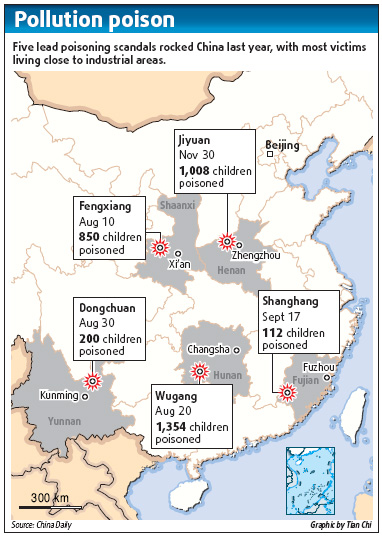
Health experts say lead poisoning poses more of a risk to children than adults because their bodies easily absorb and retain lead. Levels above 100 mcg/l can harm the nervous and reproductive systems, as well as cause high blood pressure and anemia.
In severe cases, lead poisoning can lead to convulsions, coma and even death.
Yan Chonghuai, a professor at Xinhua Hospital, also explained that the process of lowering a baby's blood-lead level causes them to lose nutrients and calcium, meaning their immune system would not function well and they would be more susceptible to colds and other illnesses.
Health campaigners have called for authorities to provide regular check-ups for children living near industrial zones to help spot potential problems as early as possible.
Youngsters are usually examined when they start kindergarten and elementary schools, although a teacher who asked to remain anonymous at Dafeng No 7 Elementary School said tests do not include checks for poisoning by heavy metals.
There is also a lack of awareness among doctors, experts warned. Hekou residents backed up this claim by telling China Daily that medics at Dafeng People's Hospital insisted the accepted blood-lead level was 400 mcg/l for adults and 300 mcg/l for children.
More than 100 families moved into the newly built Hekou neighborhood in 2004. The local government signed a contract in 2006 allowing Dafeng Shengxiang Power Supply to move its plant to the village from Jiangyin, a city about 200 km to the south.
Villagers said that the company owner, Cheng, warned the factory would cause pollution and should not be so close to a residential area. But in the agreement with the local authority, officials said they would "take care of villagers in the event of an incident".
|
|||


Wang Kouzhu, 55, whose 9-month-old grandson registered a blood-lead level of 313 mcg/l in October, blasted factory bosses and local officials for the outbreak of illness caused by pollution.
"They both have to take responsibility," she said, crying as she held her grandson Zhang Fangjian, who was initially rushed to Xinhua Hospital suffering a cold and diarrhea. "The factory should never have been allowed to move there. It is too close to people's homes."
After the scandal was exposed in the local media, Cheng offered 500,000 yuan towards treatment costs and compensation, villagers said. The Dafeng government will make up any shortfall.
The public is now widely exposed to lead pollution after years of rushed industrialization, said Jin Yinlong, director-general of the National Institute for Environment and Health under China's Center for Disease Control.
"From chinaware, children's toys to even food products, sources of lead poisoning exist everywhere in China. But the most important source is still industrial emissions, which the authorities must address," Jin told China Daily.
Villagers and local officials are not conscious of the consequences of emissions, which in turn damages healthcare awareness in less developed areas, he said. Residents in under-developed regions should be given a list of products that contain lead by local authorities to help educate them.
"Greater awareness is necessary for less informed residents who live near smelters and battery factories," said Jin. "At least it will enlighten them on when they need to report poisonings to the authorities, instead of waiting for the pollution to worsen."
Meanwhile, authorities are in a dilemma, explained Sun Ping, spokesman of the Dafeng government. He said that because the north of the province is less developed than the south, officials seize any opportunity to push economic growth and enrich people's lives.
"Economic growth depends on industries, so it will certainly give rise to pollution," he warned.