BIZCHINA> Top Biz News

|
BIZCHINA> Top Biz News
|
|
China remains firm on renminbi policy
(China Daily/Agencies)
Updated: 2009-10-05 06:59 China will stick to its current exchange rate policy and aim to maintain market stability, Yi Gang, a central bank official, said on Saturday.
Asked whether China had been facing more pressure from other countries to let the yuan appreciate, he said: "We will continue our policy setting." His remarks appeared to be responding to the Group of Seven (G7) rich nations' call for China, which is now the world's third largest economy, to strengthen the yuan. China has said it was in the process of reforming its exchange rate system to allow the yuan to move more flexibly, but that it will not allow moves that could destabilize its economy. The yuan has remained almost flat against the United States dollar since July last year, when the global financial crisis began to worsen.
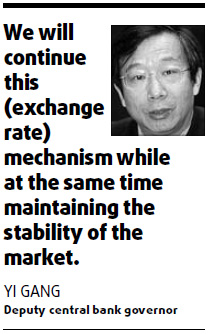
During the depths of the crisis, the little-changed yuan drew relatively little international criticism, as China provided badly needed stability to global markets. But now that the world economy is recovering, China is starting to receive more public pressure to let its currency appreciate, as a way of cutting its huge trade surplus and correcting global imbalances. Canadian Finance Minister Jim Flaherty said on Thursday his nation wants China to speed up the process of relaxing restrictions on the yuan. IMF chief Dominique Strauss-Kahn repeated on Friday that his organization believed the yuan was undervalued. China abolished a yuan peg to the US dollar in 2005 and linked its currency to a basket of currencies including the Japanese yen, euro and the US dollar. "We have an exchange rate setting of a managed float with reference to a basket of currencies and based on a market mechanism," Yi said. "We will continue this mechanism while at the same time maintaining the stability of the market." A G7 statement in April said: "We welcome China's continued commitment to move to a more flexible exchange rate, which should lead to continued appreciation of the renminbi in effective terms and help promote more balanced growth in China and in the world economy." Yi also reiterated on Saturday that China had no plans for monetary policy tightening anytime soon. "We will maintain the stability and continuity of monetary policy," he said. China's annual economic growth reached 7.9 percent in the second quarter of this year and the latest data has showed strong momentum, raising the possibility of reaching a government-set annual growth rate of 8 percent.
The G7, comprising the United Kingdom, Canada, France, Germany, Italy, Japan and the US, has been eclipsed during the financial crisis by the larger Group of 20 (G20), which includes rising powers such as China and India. Meeting in Pittsburgh last month, leaders of the G20 agreed in principle to work towards cutting global imbalances and to tighten financial regulation. "The G7 is not quite dead, but it is losing its relevance," Strauss-Kahn was quoted as saying by Emerging Markets magazine. "It's on its way to extinction." Many officials, while saying the group still had a purpose, conceded that its role would have to change as the G20 took the lead in managing the global recovery. "We have agreed to work on a more informal basis, that we step back to the way it was some years ago, and that we want to try to cut back the schedules for (numbers of) meetings," German Deputy Finance Minister Joerg Asmussen said. Recovery vulnerable The G7 stressed that the world's economic recovery remained vulnerable to setbacks, despite the IMF's forecasts of growth across much of the G7 and elsewhere in the second half of this year and in 2010. "In recent months we have started to see signs of a global economic recovery and continued improvement in financial market conditions," the G7 statement said. "However, there is no room for complacency since the prospects for growth remain fragile and labor market conditions are not yet improving. We will keep in place our support measures until recovery is assured." (For more biz stories, please visit Industries)
|
娱乐| 宝清县| 广宁县| 平安县| 玛沁县| 元氏县| 花莲市| 秀山| 固原市| 永寿县| 白河县| 曲水县| 蒲江县| 浏阳市| 黄浦区| 神池县| 子长县| 罗定市| 定陶县| 明水县| 子洲县| 邓州市| 定兴县| 锦屏县| 定南县| 沧州市| 武鸣县| 阜新市| 广元市| 缙云县| 鄯善县| 浦城县| 清涧县| 遂昌县| 西乡县| 开封市| 湟中县| 穆棱市| 九寨沟县| 辽阳市| 华容县|