BIZCHINA> Top Biz News

|
BIZCHINA> Top Biz News
|
|
Nation may have bigger say in restructured IMF
By Wang Xu (China Daily)
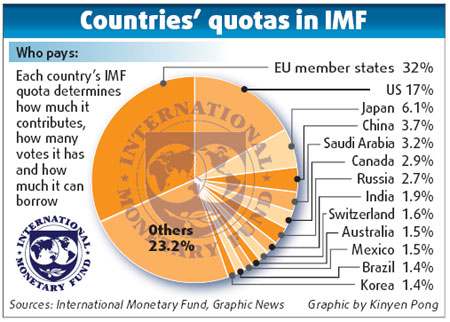
Updated: 2009-05-14 07:37 China may leapfrog Japan to have the most say after the United States in the International Monetary Fund (IMF) after a structural reform of the fund's governance, a senior IMF official said yesterday. "There is a possibility that China's quota will rise to second, when the reform concludes by 2011," Daisuke Kotegawa, IMF's executive director for Japan, told China Daily. Each member country is assigned a quota, based broadly on its relative size in the global economy; and the quota determines its maximum financial commitment to the IMF as well as its voting power. China's current IMF quota is 3.72 percent, the sixth largest. The US and Japan hold 17.09 and 6.13 percent.
"But the eventual outcome still depends on negotiations among member nations," Kotegawa said. "And it's not clear whether the Chinese government is willing to shoulder the rising responsibility accompanying a greater say." In March, Vice-Premier Wang Qishan wrote in the British newspaper The Times that it is necessary to press ahead with reform of the international financial system, and increase the representation and voice of developing countries in the IMF and the World Bank. Sun Lijian, dean of Fudan University's Economics School, said: "A meaningful reform should not only increase the voting power of developing nations, but also remove America's de facto veto power in the IMF. "If the US continues to dominate IMF decisions, there will be little change in the international financial system." Currently, some major decisions at the IMF need 85 percent of the vote but the US' 17 percent vote gives it effective veto power. IMF Managing Director Dominique Strauss-Kahn said last month that he would support reducing the majority needed to make major decisions at the fund from 85 percent, noting that the US veto power makes some decisions difficult to make. The Group of 20 leaders agreed to triple the IMF's funds to $750 billion from $250 billion in the April summit held in London so it can play a more effective role in tackling the global financial crisis. Hu Xiaolian, a vice-governor of the People's Bank of China, told an April 10 media briefing in London that China is in discussions with the IMF and will contribute to the fund by buying its bonds denominated in special drawing rights (SDRs). The IMF created the SDRs in 1969 to support the Bretton Woods' fixed exchange rate system. Their value is based on a basket of international currencies made up of the dollar, the euro, the Japanese yen and the British sterling. But Liu Jing, associate dean of Cheung Kong Graduate School of Business, is not convinced that China needs a substantially bigger role in the IMF. "It could be difficult for China to make a major increase in its contribution to the IMF. It may be better for the nation to spend its foreign exchange reserves on its own economic development, given its low per capita GDP and status as a developing nation."
(For more biz stories, please visit Industries)
|
|||||
东光县| 万全县| 阿瓦提县| 泗洪县| 溧阳市| 安吉县| 淮安市| 凤城市| 浑源县| 尖扎县| 湄潭县| 上犹县| 松原市| 阿拉尔市| 尉犁县| 巴青县| 泌阳县| 万荣县| 城固县| 濮阳市| 吉林市| 金阳县| 乐安县| 新竹县| 应城市| 探索| 凯里市| 松原市| 普兰县| 涡阳县| 东乡族自治县| 绥化市| 横山县| 长汀县| 嵩明县| 乾安县| 临高县| 延边| 宁波市| 工布江达县| 莒南县|



