BIZCHINA> Top Biz News

|
BIZCHINA> Top Biz News
|
|
Related
Color pepper prices pointer to boom in hotel occupancy
By Ding Qingfen (China Daily)
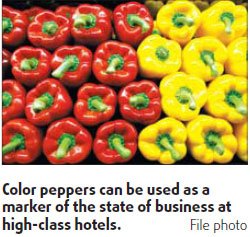
Updated: 2009-04-25 09:18 Red peppers are meant to spice up food, green peppers to add flavor and aroma. Color peppers are, for Zhang Yin, a marker of the state of business in high-class hotels. As an analyst with the Beijing-based Hu Jie Investment Advisory Service, Zhang habitually surveys the local vegetable market, besides the reports churned out by the industry, every day. To him, the price fluctuation of color peppers, an ingredient in the salad served in four- and five-star hotels, is a more convenient, and reliable index of the luxury hotels business. "My way of research," Zhang told China Daily, "is to look for cross reference on the micro-economic level to the macro-economic trend." For the last few weeks, to his surprise, the price of color peppers has been on the rise after hitting rock bottom in late 2008.
Zhang attributes the price rise to arrival of more visitors in Beijing, resulting in greater room occupancy and more meals served. He sees this as a sign of recovery from the slump caused by the global financial crisis. "Last August, after the Beijing Olympics ended, there was a sharp drop in the prices of color pepper in Beijing, and in late 2008, it hit a record low because of a sharp decline in hotel occupancy," he said. But as Zhang noticed, the price has risen from 180 yuan ($26) per box to 220 yuan since March. "It is really an improvement and definitely a positive indicator in the hotel business, although the figure is still nowhere near the high of 280 yuan seen last year," Zhang said. A color pepper vendor surnamed Wang in Xinfadi, a well-known food market in Beijing, told Zhang that late last year was the worst he had ever experienced. He had to dump much color pepper every two to three days and suffered huge losses. But now "the situation is better, with more buyers from hotels," Wang said. Zhang's logic about pepper and hotel is reasonable. "The majority of travelers staying in hotels usually choose to dine in their restaurants," said Simon Tian, general manager of Novotel Beijing Sanyuan. Therefore, the more the number of travelers checking in, the better the sales in restaurants and consequently that of color peppers. According to the National Tourism Administration, from January to February, China saw 5.29 million visitors from overseas, down 5.03 percent year-on-year, a milder setback compared to last December's decrease of 19.42 percent. Hotel operators agree that business is looking up. Henry Lee, vice-president of Marriott International China, told China Daily that "Marriott's business has been more or less hurt by the financial crisis, but now some hotels are seeing a rise in occupancy rate and sales in F&B (food and beverage)." According to Billy Zhang, director of marketing of Renaissance Beijing Hotel, the occupancy rate in Beijing's star hotels dropped by at least 30 percent year-on-year late last year, having reached 90 to 100 percent in the run-up to and during the Olympics. Traditionally, the period from April to June is the peak time for hotel business in Beijing, with the occupancy rate being around 80 percent in previous years. But this year, the figure was around 50 percent in March, Zhang said. "The performance is better than in the past few months, and the decline is easing." Novotel Beijing Sanyuan is a four-star hotel that opened for the Olympics, and "the business is getting better this year, with an occupancy rate of 70 percent," said Tian. Billy Zhang predicts the local hotel business could come back to normal in late 2009. (For more biz stories, please visit Industries)
|
磴口县| 洪雅县| 溆浦县| 柳江县| 惠来县| 安吉县| 平乡县| 长顺县| 南宁市| 宁海县| 阿合奇县| 刚察县| 英德市| 五大连池市| 桦甸市| 永胜县| 凤阳县| 达日县| 武夷山市| 开鲁县| 惠水县| 盘山县| 德阳市| 集贤县| 屏山县| 秦皇岛市| 双桥区| 化隆| 双牌县| 张北县| 弋阳县| 炉霍县| 台南市| 大丰市| 兴山县| 庆阳市| 九台市| 聊城市| 峨眉山市| 汪清县| 东平县|