BIZCHINA> Top Biz News

|
BIZCHINA> Top Biz News
|
|
Coke bid for juice maker turns sour
By Diao Ying and Ding Qingfen (China Daily)
Updated: 2009-03-19 07:22
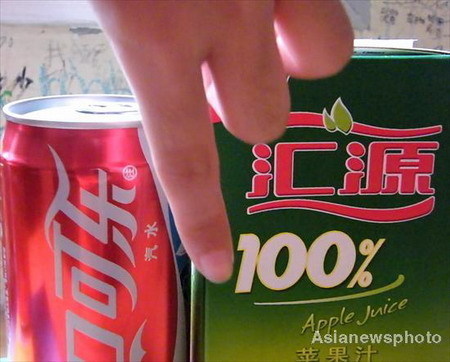
The government rejected Coca-Cola's plan to acquire beverage maker China Huiyuan Juice Group Ltd for $2.4 billion on Wednesday, citing the country's anti-monopoly law. The acquisition by Coca-Cola, announced last September, would have been the largest ever buyout of a Chinese company by a foreign rival.
"If the acquisition went into effect, Coca-Cola was very likely to reach a dominant position in the domestic market and consumers may have had to accept a higher price fixed by the company as they would not have much choice," the statement said. The MOC launched an anti-trust investigation on Nov 11 to determine whether the acquisition would harm other rivals, consumer rights or technological innovation.
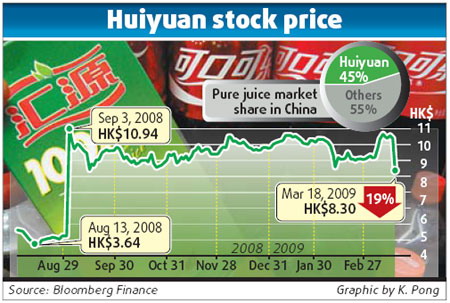 The bid was the first major deal to test the Anti-Monopoly Law, which took effect on Aug 1 last year. If passed, the deal would have been Coca-Cola's largest overseas acquisition and the company would have been able to expand its dominant position in the carbonated drinks market to the juice market. The ministry said that Coca-Cola and Huiyuan are major brands in the juice market, and therefore, the combination would have restricted competition in the industry and made it more difficult for other players to enter the sector. The ministry said the deal would also have squeezed development space for other small- and medium-sized enterprises, and is not good for the development of the country's juice industry. Huiyuan said yesterday that it respects the decision made by the ministry, and production would continue as normal. The company's share dived 19.24 percent to HK$8.30 yesterday before trading was suspended shortly after the market opened in the morning.
Muhtar Kent, president and chief executive officer of Coca-Cola, said: "We are disappointed, but we also respect the MOC decision." He said the company had put a tremendous effort into providing all the relevant materials to the MOC to ensure that they had all the information available and understood the transaction. "We were looking forward to working with the excellent Huiyuan team to stimulate new growth for the Huiyuan brand." He said the company will now focus all of its energies and expertise on growing existing brands and continuing to innovate with new brands, including in the juice segment. Huang Wei, beverage analyst at China Jianyin Investment Securities, said: "The ministry's decision is not surprising. But it's not good for Huiyuan, whose market share will probably shrink as international players such as Coca-Cola invest more in the juice market." Coca-Cola's offer to buy the Hong-Kong listed company was seen as a major strategic move to tap China's fast growing juice market. While the world's largest soft drink manufacturer dominates the carbonate market in China, its share in the juice market is relatively small. On the other hand, Huiyuan is the largest juice beverage maker in China, with over 45 percent of the pure juice market in the country. It also controls more than a tenth of the Chinese fruit and vegetable juice market that grew 15 percent last year to $2 billion. Coca-Cola has a 9.7 percent market share and dominates in diluted juices. China is Coca-Cola's fourth-largest market and a key battleground with rival PepsiCo Inc. Huiyuan's founders and major shareholders had endorsed the sale as a way for the company to improve product development and marketing. An MOC official said Coca-Cola had tried to address the negative effects on competition after it sought government approval for the deal in November, but its efforts did not meet the requirements of regulations. "It is only an isolated case, and it does not suggest any change in China's policy on foreign investors," the official said. The MOC said it has investigated 29 proposed acquisitions under the anti-monopoly law since August and approved 24. Xinhua, Reuters and AP contributed to the story (For more biz stories, please visit Industries)
|
|||||||
安陆市| 五家渠市| 阿坝| 涟水县| 奉节县| 田东县| 资阳市| 涪陵区| 色达县| 株洲县| 上思县| 钟祥市| 繁昌县| 大洼县| 东城区| 册亨县| 平南县| 巨野县| 东辽县| 昌黎县| 金沙县| 扶沟县| 普兰店市| 凤山市| 松潘县| 梁山县| 梅河口市| 肥乡县| 灌阳县| 望都县| 潮州市| 乌兰浩特市| 琼海市| 翼城县| 叙永县| 庄河市| 永胜县| 黄浦区| 鹤庆县| 霍林郭勒市| 枣强县|