BIZCHINA> Industries

|
BIZCHINA> Industries
|
|
Environment: Benefit from going green
By Zhao Tingting (China Daily)
Updated: 2009-02-27 10:59 China can reduce its greenhouse gas emissions by 50 percent if it adopts green technologies. This in turn would help the country become a "green economy" by 2030, said a report released yesterday by global consulting firm McKinsey & Co.
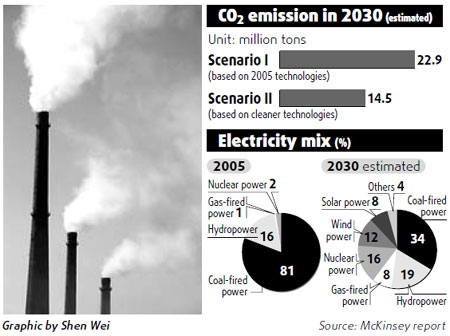 The report also said China can reduce its oil imports by up to 30 to 40 percent and its coal demand by 40 percent and greenhouse gas emissions by 50 percent by 2030. This can be done through investments in technologies that are commercially available and those not widely understood or deployed nowadays. McKinsey estimated that from now on until 2030, additional investments of 1.5-2 trillion yuan would be needed each year to deploy green technologies.
"Because of its relatively early stage of economic development and the rapid pace at which the nation is expected to grow over the next few decades, China can install technologies that are available today into the buildings, cars, and power plants of tomorrow," said Jonathan Woetzel, the Shanghai-based director of McKinsey and the co-author of the report. "As some observers have pointed out recently, China has a unique opportunity to avoid the path that other nations have taken if it now makes the decisions that will ensure a greener future." Martin Joerss, partner in McKinsey's Beijing office and co-author of the report, said "China could be at the forefront of a global green revolution," in two decades. For example, by significantly ramping up investment in clean energy technologies such as nuclear, wind, solar and hydropower, China could cut its reliance on coal as the source of energy for its power plants from 81 percent of total electricity generation today to 34 percent by 2030, the McKinsey report said. The report noted that China has consistently improved the "carbon efficiency" of its economy over the past 15 years. Through a combination of government policies and industry-wide initiatives, China has reduced the amount of carbon dioxide and other greenhouse gases that it produces for every unit of GDP by 4.9 percent each year on average over the past 15 years, compared with just 1.7 percent in the US and 2.7 percent in Germany. "The green road cannot guarantee us definite climate safety purely based on individual country's respective conditions and motivations, unless their seriousness, speed and perseverance are well coordinated under one science-based regime," said Zhang Jianyu, head of the US-based Environmental Defense Fund's China office. However, Huang Shengchu, president of the China Coal Information Institute, said he believed the nation would have to continue relying heavily on coal-fired power. "China's coal-fired power will account for 60 percent of total power output by 2030, although it is declining," he said. (For more biz stories, please visit Industries)
|
|||||
黔西县| 芦山县| 岐山县| 周至县| 龙州县| 永修县| 房产| 伽师县| 那坡县| 新密市| 灵寿县| 会理县| 乾安县| 绥阳县| 昌图县| 称多县| 齐河县| 嘉义县| 济源市| 宁夏| 醴陵市| 定襄县| 万山特区| 龙江县| 饶平县| 沙雅县| 漠河县| 永城市| 志丹县| 霸州市| 文成县| 鹤峰县| 楚雄市| 手游| 正镶白旗| 沙洋县| 吴旗县| 板桥市| 中超| 太湖县| 黎川县|



