BIZCHINA> Wen's Lens

|
BIZCHINA> Wen's Lens
|
|
Related
Questionable futures
By You Nuo (China Daily)
Updated: 2008-12-08 07:58
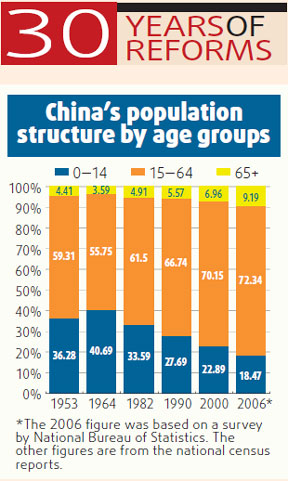
 One of the key tasks of China's economic reform is to create jobs for the nation's younger generation. But in the meantime an equally significant change is taking place. It's the rapid aging of the general population, thanks to the government policy encouraging couples to have only one child, and, in part, to the spread of the urban lifestyle (in which people are busier and tend to have fewer children).
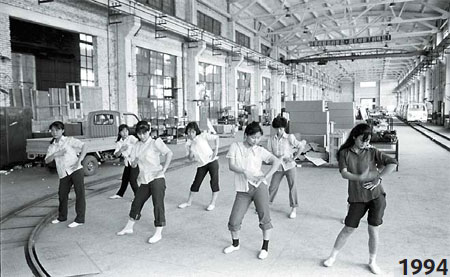
There is an inherent challenge. If development is to be sustained at the same level for the next 30 years generating the same - or more - wealth, it will have to be generated by using declining amounts of manpower. In 30 years the workers during their dance break in our black-and-white photo, taken in 1994 in a State-owned factory in Dalian, a northeastern city in China, will all be around retirement age.
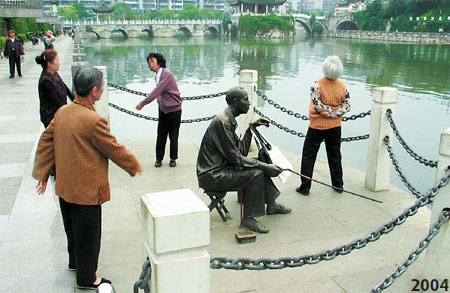
Will enough be provided for them to enjoy their lives - at least as the old folks in our color photo, taken as they were doing morning exercises in a Guiyang park in southwestern China - appear to be doing? People tend to overlook problems in what seems obvious. How will this economy sustain the lifestyles of a far larger number of retirement-age citizens with a far smaller pool of young workers 30 years from now? Will there be enough resources? Or will there be difficulties? Seldom, it seems, have people in this nation asked such a question. At first sight those retirees may not seem to demand as much. They are not spending money on fancy clothes or expensive sports, as some of their children and grandchildren do. But even without the finery, their plain and quiet lives, under the protection of a decent pension and medical insurance, may claim an enormous amount of society's resources. A look at the demographic pattern in the developed economies reveals enough of this future challenge. In the United States, some 75 million baby-boomers are ready to retire and they have only some 30 million younger successors for their jobs, according to a recent research by the Boston Consulting Group. In the eurozone, by 2050, the size of the working-age population will also decline by 48 million. In fact, there already are some considerable uncertainties waiting for China. Just think how many citizens lost their savings on the bonds and stocks that later turned out worthless in the recent business bubbles in the developed countries. The existing global financial system, which China is only a smaller copy of it, is deeply flawed and may not be adequate to provide security to the world's industrial population. There is a danger that the simple lifestyles of today's retired workers may become the envy of their children when they reach their retirement age - unless China's economic reform can lead to the successful reinforcement of its financial system. (For more biz stories, please visit Industries)
|
广水市| 张家界市| 贵南县| 巴里| 城口县| 红安县| 建德市| 石柱| 拉萨市| 什邡市| 津市市| 磴口县| 贵德县| 永修县| 新平| 陆川县| 石楼县| 德钦县| 慈溪市| 黄平县| 南通市| 铜梁县| 苏尼特右旗| 文化| 龙口市| 萨迦县| 丰县| 叙永县| 彰化市| 高邮市| 钦州市| 乌鲁木齐市| 山东省| 新津县| 定边县| 保德县| 盐城市| 鹤壁市| 合川市| 富平县| 太原市|