BIZCHINA> Top Biz News

|
BIZCHINA> Top Biz News
|
|
Related
Auto sales face sharp drop as confidence falls
By Li Fangfang (China Daily)
Updated: 2008-10-20 09:33
At this time of year, China's passenger car dealers normally bask in a warm autumn glow, with September and October being the country's two best months for auto sales.
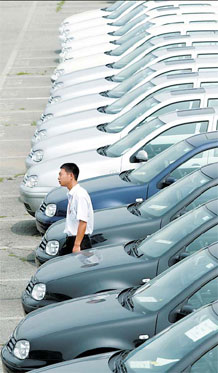
But, this year is different. The chilling winds of the global credit crisis, inflation and sinking consumer confidence are being felt on dealers' forecourts across the land. China's passenger car sales fell in August from a year earlier, the first monthly decline in more than two years. According to China Association of Automobile Manufacturers (CAAM), 451,300 cars were sold in the world's second-largest auto market in August, down 6.24 percent year-on-year. Earlier this month, CAAM reported that sales continued to slide in September, with the monthly figure falling 1.44 percent from a year earlier to 552,800 units. Sales growth in the sedan segment cooled from more than 20 percent in the first quarter to 10 percent in the second quarter. "Too many adverse factors are putting a damper on auto sales this year," says Hui Yumei, an analyst from auto research firm Sinotrust. "The readjusted vehicle purchase tax and higher fuel prices can be blamed for the unusual slowdown, as well as consumers delaying their purchases because of the expectation of a price cut after the Anti-Monopoly Law was implemented in August and their flagging enthusiasm in the slumping stock market," says Hui. "The Beijing Olympics also kept potential purchasers from showrooms." Fuel prices rose on two occasions in the past few months, first in June by 20 percent and on October 7 by a further 4 percent in Beijing, in a bid to cut oil consumption and tackle pollution. And, in an effort to drive more potential buyers away from huge gas-guzzlers, in September the central government hiked the sales tax on big cars, while cutting the levy on smaller vehicles, in an effort to curb fuel consumption and control emissions. The tax on passenger vehicles with engines bigger than 4 liters was raised from 20 to 40 percent, while it was cut from 25 to 15 percent for vehicles with engines between 3 and 4 liters. To encourage purchases of small vehicles, the tax on cars with an engine size at or less than 1 liter fell from 3 to 1 percent. However, the government's supposed shot in the arm for sales of smaller autos appears to be a bit of a damp squib. In August, the market share for passenger cars with engines at or smaller than 1 liter was a mere 7.67 percent. Jin Yibo, a spokesman for Chery Auto Group, explains that the tax adjustment only cuts the price of more fuel-efficient cars by several hundred yuan, not enough to convince customers that smaller is necessarily beautiful. The unexpected slowdown in sales has had an obvious impact on the market. Mazda Motor Corp last month halved its sales forecast at a Chinese venture selling compact cars, admitting it goals were too high. According to CAAM, passenger vehicles sales in the first half of the year stood at 3.6 million units, 17.07 percent up from the same period last year. Inventories of unsold new vehicles in China rose about 50 percent to a four-year high at the end of June, as sales growth slowed unexpectedly while automakers boosted output. The backlog reached 170,000 vehicles at the end of June, the highest since the previous peak of 200,000 at the end of June 2004, according to China Securities Journal, which quoted Cheng Xiaodong, chief auto analyst with the price monitoring center at the National Development and Reform Commission. "The fuel price hike, the slowing economy and the rising vehicle purchase tax mean that I'm not optimistic about a recovery in car sales in October," says Rao Da, secretary-general of the China Passenger Car Association. "A decline is very likely in the first half of 2009, but things could improve in the second half as government moves to relax monetary policy gradually take effect," Rao says in a research report released this month. He cut his estimate for 2008 China car sales growth to 5-6 percent, from 6-8 percent last month. "We have to say goodbye to the 20 percent-plus growth rate and our expectation that sales and production this year will break the 10-million-unit barrier," says Jia Xinguang, an independent auto analyst based in Beijing. "Production in the first eight months, 6.54 million units, still lags behind the 10 million target by 3.45 million units, which means the goal can only be reached if production exceeds 862,500 units in each of the coming four months. However, this seems to be impossible," says Jia. He forecasts 8 percent growth this year, with production reaching 9.5 to 9.6 million units, up from 8.88 million units last year. (For more biz stories, please visit Industries)
|
江口县| 昭觉县| 罗平县| 治多县| 华阴市| 陆河县| 永丰县| 崇文区| 遂宁市| 东阳市| 米林县| 宁陵县| 沿河| 德江县| 东山县| 苗栗市| 许昌市| 彩票| 远安县| 且末县| 湘潭县| 淮北市| 申扎县| 朔州市| 柳江县| 屯门区| 富锦市| 仙桃市| 海晏县| 临猗县| 姚安县| 深圳市| 航空| 黄浦区| 华亭县| 永和县| 孟津县| 平塘县| 大厂| 准格尔旗| 东安县|