BIZCHINA> 30 Years of Reforms

|
BIZCHINA> 30 Years of Reforms
|
|
Related
A massive migration of workers
By Zhang Ran (China Daily)
Updated: 2008-10-06 13:56
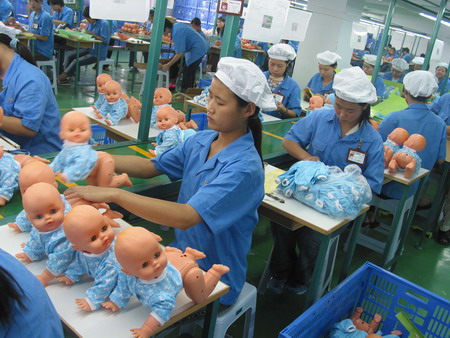
Twenty-one-year-old Zhen Bo has a dream. The young man, who works in a factory producing jeans in Foshan city, Guangdong province, manages one dyeing machine and four people. Three years from now his dream is to manage the entire dyeing plant and all 12 employees. He also hopes his salary, which is 4,500 yuan, will be around 6,000 to 7,000 yuan by then. Zhen comes from a small village in northern China's Hebei province, where his father, and grandfather are all farmers who never left the land. He quit school soon after finishing the nine-year obligatory education requirement. After helping his father with farm work for a while, he found a job as an apprentice dye worker in a State-owned garment-making plant in Shijiazhuang, the capital city of Hebei. Three years later, his master recommended him as an honest, hard working guy to a factory in Xintang Area of Guangzhou city, where he could earn 3,800 yuan a month in the Pearl River Delta, three times the wages he made back at home. A year after that, Zhen found his current job in Foshan, where he is making 800 yuan more. Zhen is one of millions of migrant workers who have left their rural homes to find better employment in factories in Guangzhou, Shenzhen, Suzhou and elsewhere in the Pearl River and Yangtze River deltas. Like Zhen, most expect that their wages and careers will improve with the relocation. A report released by Fudan University at the beginning of the year says the average monthly income of Chinese migrant workers reached 1,200 yuan in 2007, an increase of 200 yuan over the previous year. The figure was around 500 to 800 yuan in 2005. Comparatively, a rural Chinese worker averaged 360 yuan a month in the same year, according to the National Statistics Bureau.
For the past three decades, it has been the longing to live better and learn more that has pushed these young laborers to leave their mostly rural hometowns. These migrant workers feed their dreams in cities primarily along the eastern or southern coasts - which required a large amount of men and women to work in the growing factories. As these cities continue to expand, these young workers' ambitions grow with them, coming together to forge the strength to power a factory, a city's growth and a country's development. China's migrant workers now account for more than 13 percent of the country's population. The provinces of Sichuan, Hunan, Hubei, Jiangxi and Guangxi Zhuang Autonomous Region are areas that have seen the greatest outflow of migrant workers. A research report published in January 2006 in the Study Times showed in 2004, Sichuan province had 14.9 million migrant workers. This number, accounting for 30 percent of Sichuan's population, is equal to the total population of a medium-sized country. And 2 million rural households in the province saw the whole family working outside the province. This phenomenon is by no means a mere transfer of rural laborers, rather it's a massive social change from farmers to workers and a mass migration from rural areas to cities, or "urbanization". (For more biz stories, please visit Industries)
|
黑龙江省| 红河县| 会泽县| 侯马市| 绥芬河市| 辉南县| 苏尼特右旗| 茂名市| 浏阳市| 商水县| 昆山市| 曲沃县| 日喀则市| 丁青县| 凌云县| 六安市| 清河县| 志丹县| 铜梁县| 上杭县| 芮城县| 丹巴县| 永安市| 塔城市| 郴州市| 汉沽区| 茂名市| 二手房| 夏邑县| 阿勒泰市| 茶陵县| 沙雅县| 缙云县| 乡城县| 左云县| 崇阳县| 吐鲁番市| 谷城县| 斗六市| 枞阳县| 柳江县|