|
|
 |
 Raymond Zhou:
By jingo, they're mad!  Op Rana:
Consumerism and politics of waste   Ravi S. Narasimhan:
Lessons from SARS have to be applied  Alexis Hooi:
Beyond the death and destruction  Overseas fever of Tsingtao Beer
By Zhang Ran (China Daily)
Updated: 2008-09-08 09:59
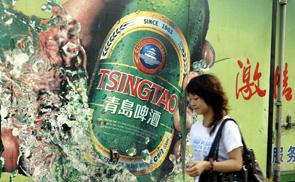
In October 2002, Tsingtao Beer launched its biggest private placement in the capital market. Following a strategic agreement with the world's No 1 brewer Anheuser-Busch, Tsingtao Beer issued 1.416 billion yuan worth of convertible bonds to its foreign partner. The bonds were sold in three batches, each of them having a 7-year life span. The private placement led Anheuser-Busch to take a 27 percent share in Tsingtao. Four waves It has been 15 years since Chinese companies were first listed overseas. Since then, some companies have enjoyed hot pursuit; some saw their shares exceeding the issue price, and some shares are now merely worth a few cents. The overseas stock market had altogether witnessed four waves of "China fever". Soon after the China Securities Regulatory Commission was established in 1992, China saw its first batch of companies listed abroad. Besides Tsingtao Beer, they included Sinopec Shanghai Petrochemical Co, Ma Steel, and Yizheng Chemical Fiber Co Ltd. Most were in the manufacturing industry due to China's long history of manufacturing and its governmental support of the industry. Also foreign investors saw the country's GDP growing two times faster than the average world economy and they were confident that China had great potential. However, the first China fever wave quickly faded. Part of the reason was due to the Mexican financial crisis. But Chinese companies' flat mid-term and year-end financial results, as well as unsophisticated management experience, were more important reasons to disappoint international investors. They started to doubt the future of the Chinese manufacturers. It was true. Even though many overseas listed Chinese companies had conducted share restructuring, the lack of a sophisticated system in corporate governance, especially a system to encourage the management level, still blocked the company's performance. After the first wave, Wall Street soon found alternatives to Chinese manufacturers. This time, they cast their eyes on infrastructure. Flagship companies in the aviation, railway, highway, and power industries were heavily pursued. But like the first batch of overseas listed companies, when the slowdown of China's economy threw many infrastructure builders into losses, the second wave shrank. At the end of 1996, red chips began to lead the third wave. Red chips are mainland firms registered and listed overseas. These companies are mainly listed in Hong Kong and via American depositary receipts, their securities can be traded on the New York Stock Exchange. Some include China Merchants Holding (International) Co Ltd, Huarun Resource Enterprise Ltd, Shanghai Industrial Holding Ltd, and Beijing Enterprise Holding Ltd. Foreign investors believed that since these companies were registered in Hong Kong, they might have more flexible management styles. However, that fever ended in October 1997 with the Asian financial crisis. On February 17, 1999, Qiaoxing Univ Telephone, a Guangdong-based telephone manufacturer, was listed on the NASDAQ, becoming the first Chinese private company to do so. On its debut, the company's shares soared as much as 268 percent. On July 14, 1999 China.com was listed on the NASDAQ. Its share price soared from $20 to $67.2 on the first trading day, a 235 percent increase. The worldwide Internet boom triggered the fourth wave of overseas listings, which still linger. The legend of Microsoft and Google.com on NASDAQ encouraged Chinese hi-tech firms, and new energy firms as well as firms from other areas to seek opportunities in the overseas capital market. Unlike the former three waves, most of these companies are privately owned and widely known by Chinese people. Companies such as Sina.com, Sohu.com, Baidu.com, Suntech Power Co Ltd, New Oriental Education & Technology Group, and Alibaba.com.cn went to the US capital market one after another, creating China's own wealth legends overseas. And the stories are still continuing.

|
浦县| 鸡西市| 北海市| 绵阳市| 芦山县| 嘉禾县| 扶绥县| 萍乡市| 铜山县| 天津市| 澄江县| 莱芜市| 承德县| 天水市| 常德市| 葫芦岛市| 沙河市| 柞水县| 咸宁市| 宁武县| 双柏县| 洛阳市| 朝阳区| 灵宝市| 贵德县| 舒城县| 永登县| 南通市| 古蔺县| 太谷县| 红安县| 温泉县| 徐汇区| 资阳市| 探索| 曲阜市| 砚山县| 介休市| 开封市| 平昌县| 香港|