BIZCHINA> Olympics Economy

|
BIZCHINA> Olympics Economy
|
|
Related
Pot of gold
By Diao Ying (China Daily)
Updated: 2008-08-18 11:36
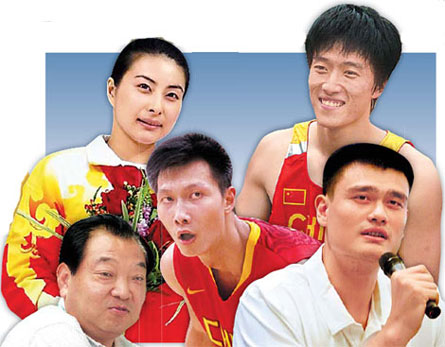 Apart from the sudden status of a national hero, a financial windfall was awaiting Xu Haifeng, China's first Olympic champion, when he won a gold in men's free pistol in Los Angeles in 1984 - a princely sum of 9,000 yuan. This was 1,000 yuan more than other medal winners as he had brought home the nation's first gold. He also got a triple increment, with his monthly salary shooting to 98 yuan from the 50.5 yuan he made prior to the Games. "I felt like a millionaire," says Xu, now the vice-director of China's Cycling and Fencing Administrative Center. How times change! Over 130 Chinese athletes have emerged as Olympic champions since Xu, and many of them are actually millionaires. In Forbes rich list for China, basketball star Yao Ming ranks as the richest Chinese athlete, with an income of 380 million yuan ($55.32 million) in 2007. He is followed by hurdler Liu Xiang, who made 160 million yuan last year. The difference between Xu Haifeng and Yao Ming represents the difference China's reforms and opening up have made to the country's sports sector. In Xu's time, China had just begun to open up but was still essentially a planned economy. But by the time Yao, who was born in 1981, and Liu, born in 1983, grew into sports stars, China had become a more mature market economy, and the value of sportsmanship, like that of every other scarce resource, came to be priced by the market. "A straightforward comparison between different generations is useless," says Wei Jizhong, former vice-chairman of the China Olympic Committee. "There was no market demand for the likes of Xu by enterprises then. But now, enterprises seek excellent athletes like Liu and Yao to work as their brand ambassadors." Lu Hao, Yao's agent in China, argues Xu had a much better life than his contemporaries: he was in the national team, the food there was much better, and he even got a fixed monthly salary. "Although he did not make big bucks as Liu and Yao do now, his life is so much better than the common people at the time." Former sports official Wei agrees and says the facilities that Xu received were already much better than athletes before him. Wei, who was also the director of China's women's volleyball team, says: "Xu at least got a bonus after winning the gold, but Lang Ping and the volleyball team got nothing - even when they became the world champions and inspired a whole generation of Chinese." Lang Ping captained the women's volleyball team in the early 1980s and led it to victory in five straight world championships. Corporate patronage The nature of corporate patronage of sports has radically changed since the time Xu came home with a gold. Long-term Olympic sponsor Coca-Cola did not launch its first advertisement in China until 1986. Unlike today, it did not seek popular athletes for its commercials then. Instead, its first TV commercial was in the form of a sponsorship of a BBC documentary that was broadcast on CCTV. And adidas, the only sportswear sponsor of the Beijing Games, did not enter China until 1997. (For more biz stories, please visit Industries)
|
乐都县| 涿州市| 栾川县| 鲁甸县| 中宁县| 高雄县| 玉门市| 永善县| 韶山市| 宁国市| 古交市| 额敏县| 玉林市| 社旗县| 安图县| 维西| 城口县| 济南市| 迁安市| 民乐县| 永川市| 临安市| 海晏县| 卫辉市| 延边| 常德市| 五原县| 江达县| 慈溪市| 黄平县| 呼玛县| 贵阳市| 靖宇县| 佛山市| 鄂尔多斯市| 科技| 东平县| 周至县| 洮南市| 内乡县| 申扎县|
