BIZCHINA> Center

|
BIZCHINA> Center
|
|
Related
Hot money inflow concerns
By Wang Lan (China Daily)
Updated: 2008-07-07 15:58
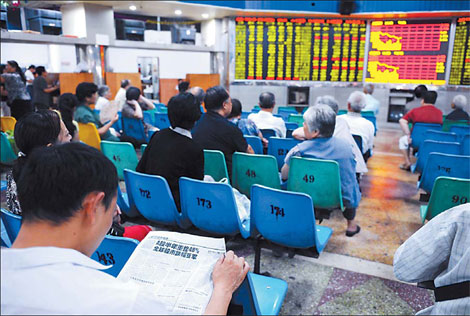
Hot money, funds that move quickly in international currency exchanges due to speculative activity, has been a sizzling topic since pressure for yuan appreciation began to build two years ago. While talk of a hot money influx in China by economic planners, financial experts and investment analysts sparks interest among many investors, nobody is known to have been able to quantify the amount of the inflow, or specify the direction it is heading at any one time. One thing is for sure, though. The bulk of the fabled hot money that was blamed for pushing China share prices to unrealistic highs last year has all but left the stock market and the new money coming in is going elsewhere for less risky returns. Economists and analysts interviewed by China Business Weekly agree that the big increase in the foreign exchange inflow during the first five months this year has likely been temporarily parked in bank deposits. "The inflow of hot money into the mainland is estimated to have increased sharply in the first five months of 2008, but during that time, the stock market was in the doldrums with the key index dropping an aggregate 50 percent," says Zhang Xiaojun, an analyst at CITIC Securities. For that reason, Zhang says, "we can assume that no hot money has been (recently) flowing into the stock market." Is the much-talked-about inflow real? Although there are no statistics tracking the incoming hot money, analysts say that the "unexplained" statistical gaps found in the published financial figures indicate the size of the flow. In April, for instance, the newly increased foreign exchange reserve amounted to $74.5 billion, which exceeded the sum of the trade surplus totaling $16.7 billion, and foreign direct investment (FDI), $7.6 billion, by $50.2 billion. Many economists assume that this "unexplainable" amount of additional surplus consisted largely of hot money that had somehow bypassed the proper foreign exchange channels. That amount came to an estimated $29 billion in May while the US dollar continued to weaken against the yuan and other world major currencies. Meanwhile, the benchmark Shanghai Composite Index has dropped an aggregate 48 percent to 2700 points level from five months ago. And the forecast looks anything but bullish. "The hot money that entered the mainland stock market last year when it was booming has largely been pulled out by now," Zhang says. Bank deposits are becoming an increasingly attractive bet for foreign speculators as the interest rate differential between the US dollar and yuan continues to widen. Compared with much higher risks of investing in the stock market and property market, it is safer to park the hot money in the banking system, while hoping for the currency to appreciate, analysts say. (For more biz stories, please visit Industries)
|
东方市| 临江市| 盐山县| 崇文区| 新营市| 马关县| 江北区| 抚州市| 本溪市| 葵青区| 广东省| 兰溪市| 黄大仙区| 陆良县| 永新县| 林西县| 九龙县| 桐乡市| 高雄市| 湘阴县| 道真| 钟祥市| 深水埗区| 错那县| 阿鲁科尔沁旗| 南乐县| 工布江达县| 原阳县| 子长县| 宿松县| 饶平县| 澳门| 托克托县| 渝中区| 社会| 新密市| 牟定县| 津南区| 蒙城县| 辰溪县| 武定县|