BIZCHINA> Review & Analysis

|
BIZCHINA> Review & Analysis
|
|
Related
Housing policy vital to fair and stable society
By Hu Shaowei (China Daily)
Updated: 2008-06-24 11:04 Rocked by the subprime crisis in the United States and its threats to the financial markets across the country, many economies in the West have come close to stagflation, seeing both slow economic growth and highflying inflation. Many analysts thought the emerging economies might not suffer as remarkable shocks from that for they are relatively less involved in the subprime market. However, this opinion has just been challenged by the recent financial woes in Vietnam. Compared with Vietnam, China has obvious merits in the size of its economy, the amount of its foreign exchange reserve and its capacity to control the economy. But these merits do not free the country from the potential threat to its economic soundness as well as to the financial market. Judging from the current situation, China is seeing a similar slump in the stock market to that of Vietnam, while the Chinese property market has not yet had a remarkable recession. The property market is now an important pillar of China's economic growth.
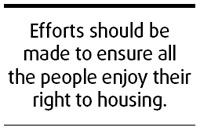
When the property market and the industry are facing a delicate moment for possible changes in the direction of development, the smooth growth of the property industry bears significance not only in driving the economic development, but also in safeguarding national economic security. To tackle the current difficulties, the authorities should fully carry out policies about affordable housing while breaking out of the property price bubbles and reducing the speculative funds. International experiences have proved that the property industry could find a sustained driving force in the government's effort of offering more affordable houses and promoting ownership of homes. It is a universal principle of all countries to guarantee citizens' right to get proper shelter. The experiences from the developed countries indicate that almost all market economy countries regardless of their economic model, including the United States, the United Kingdom, Sweden and Singapore, have taken their own measures to meet housing policy targets. And their common goal is to promote ownership of homes. China started to reform its housing policies in 1997, since when the authorities reiterated over and again that the housing policy would cover different groups accordingly. Families of ultra-low income should have access to the low-rent houses offered by the government, so that the groups with the least financial resources could be sheltered with the government's assistance. Families with low and middle incomes should get their houses on the real estate market, while the State gives favorable treatment either with direct subsidies, low-interest loans or tax breaks. As for people with high incomes, they should buy their houses from the property market with their own wealth. Nearly all developed countries attached high importance to the housing issue at the early stage of their economic takeoff. With the principle of ensuring shelter for everyone, the governments launched a variety of policies to ensure the people had proper homes. Based upon that, the property market was encouraged and homeownership was promoted. This process was withheld until the property shortage was no longer a problem for the society. By then the government no longer has strict limits upon the property prices and rents, no longer builds more low-rent houses, but begins to subsidize residents to own their homes. Such housing policies were practiced in many countries and worked well there, as it happened in Singapore in the 1960s. Compared with these successful examples, the housing policies of China have a touch of "overt marketization" because the country lacked an adequate supply of low-rent houses and other measures to ensure the supply of affordable houses. The low and middle income groups did not have enough of favorable treatment as a whole. The current supply of low-rent housing, low-priced housing and other favorable polices could not shelter the large low-income population, not to speak of covering the middle-income groups with flexible means. Fortunately, the housing policies saw remarkable changes in 2007. The authorities paid a lot of attention to the role of housing policies in promoting social fairness and urbanization besides recognizing the property's character as a commodity in the market. In the report to the 17th National Congress of the Communist Party of China in 2007, General Secretary Hu Jintao stressed that efforts should be made to ensure all the people enjoy their right to housing. To this end, it is necessary to establish a mode of building and consumption that goes well with the real situation of China, making better use of land, resources and energy and improving the housing conditions of most families. With the world's biggest population, it is inevitable that China will see a relatively limited supply of land and energy, especially when it comes to the housing issue. The homes should be "compact" in size and friendly in energy consumption. Now housing receives attention from the highest authorities as one of the issues related to the vital interests of common people. After the housing policy saw a profound transition in its concept, the property industry will see the same extensive changes. After more land and capital are poured to support constructing low-rent and low-priced housing, a diversified supply of all types of housing products would be offered to people, from which they could choose the ones most suitable for them. The author is an economist with the State Information Center. (For more biz stories, please visit Industries)
|
台北市| 仁寿县| 杂多县| 尖扎县| 瓮安县| 增城市| 栖霞市| 辽源市| 深水埗区| 耿马| 延安市| 兴宁市| 屏南县| 香港 | 泗洪县| 石台县| 玉田县| 云林县| 平顶山市| 晋城| 剑阁县| 彰武县| 奉节县| 西乌珠穆沁旗| 哈密市| 龙海市| 武功县| 望奎县| 渝北区| 朝阳区| 滨海县| 昭平县| 榆林市| 尚志市| 华安县| 师宗县| 体育| 宁国市| 蒙阴县| 资中县| 南木林县|