BIZCHINA> Review & Analysis

|
BIZCHINA> Review & Analysis
|
|
Fitting China into your global footprint
(chinadaily.com.cn)
Updated: 2008-05-23 15:20 How can companies from outside China benefit from China's emerging skills in advanced R&D? It is a multi-faceted question. Many considerations have to be factored in before a convincing choice among a multitude of options can be made. As a result, the decision process often turns out to be time-consuming and expensive, as each new product or project proposal requires in-depth evaluation. What to do every time somebody walks into your office with a new great China idea or … a potential China nightmare! Global business executives would benefit, therefore, from an effective decision logic that fits China into their global manufacturing and R&D footprint. It should lead to a portfolio of Chinese activities that ensures a sustainable competitive advantage on both local and global markets. The "China fit" logic that we have applied in our work with global companies seeking expansion into China is based on the following principles: · Think in terms of competencies, not products; Below we describe each of these principles in more detail and explain the analytical steps through which they can be put into practice (see Exhibit 1). Exhibit 1: Principles and analytical steps
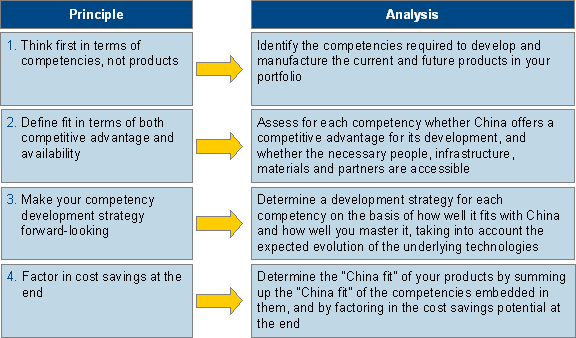 1. Think first in terms of competencies, not products When you evaluate what makes sense to put in China, move away from traditional product thinking. Carry out the analysis on the basis of competencies instead. A competency refers to know-how or capabilities a company possesses in order to develop, manufacture and sell its products. In this article, we focus on development and manufacturing competencies. These can be used for state-of-the-art products (e.g., electronic sensor design) or straightforward commodities (e.g., sheet metal processing and welding). Traditional product thinking focuses on splitting up a product by component, and then deciding on where each of the components and the final product are best developed, manufactured and assembled. A competency-based approach, on the other hand, focuses on splitting up products by what you need to know to successfully develop and manufacture them, and then deciding on where this capability is best built up (see Exhibit 2). (For more biz stories, please visit Industries)
|
龙井市| 黔江区| 公主岭市| 河源市| 杂多县| 汉阴县| 二连浩特市| 柘城县| 兴文县| 沾化县| 赤壁市| 阳东县| 绍兴市| 贵南县| 祁阳县| 资溪县| 景泰县| 邵武市| 普洱| 长顺县| 沾益县| 清远市| 阿拉善盟| 铁岭市| 秀山| 昌江| 茶陵县| 维西| 清丰县| 和静县| 利津县| 云和县| 香河县| 汕尾市| 斗六市| 含山县| 黄大仙区| 云龙县| 新安县| 鸡泽县| 洞口县|
