Survey shows better rural facilities
Updated: 2008-02-22 09:26
Rural infrastructure and social services have improved remarkably in recent years, thanks to government efforts to boost the countryside, the nation's latest agriculture census has revealed.
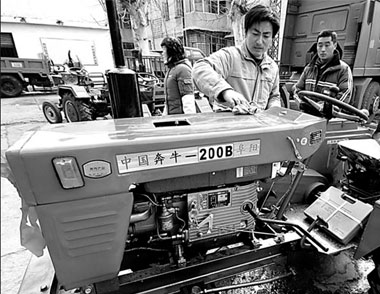 A farmer in Mengcheng county, Anhui province, cleans a tractor he bought earlier this month. [China Daily] |
The National Bureau of Statistics yesterday released its first report based on the 2006 census, which is designed to reflect the overall development of rural areas and the agriculture sector, as well as the living standards of rural residents.
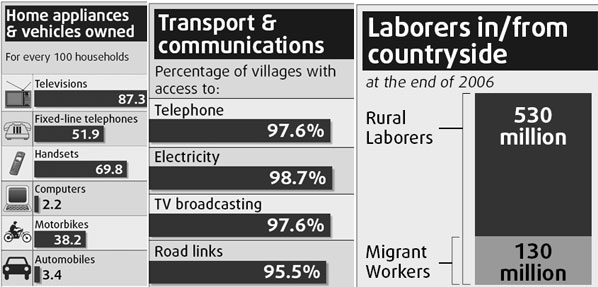
The percentage of villages which had access to road links, telephone services, electricity and TV broadcasting by the end of 2006 were 95.5 percent, 97.6 percent, 98.7 percent and 97.6 percent, according to the survey.
For every 100 households in rural areas, there were 87.3 television sets, 51.9 fixed-line telephones, 69.8 mobile phones, 2.2 computers, 38.2 motorbikes and 3.4 automobiles.
Meanwhile, 74.3 percent of the villages had clinics; and at the township level, 98.8 percent of towns had hospitals, and 66.6 percent, nursing homes for the elderly.
"The figures show the government's increased spending to improve rural livelihoods has started to pay off," said Du Zhixiong, a researcher at the Rural Development Institute of the Chinese Academy of Social Sciences (CASS).
The central government has launched a slew of initiatives in the past few years to speed up the development of the countryside, which has lagged behind urban areas over the years.
The aim is not only to bridge the income gap between urban and rural areas, but also improve the social services in the countryside. Last year, the per capita income of rural residents averaged 4,140 yuan ($580), about a third of earned by urban residents.
The central government plans to increase its budget for rural investment by more than a fourth to 520 billion yuan ($72.8 billion) this year, Chen Xiwen, director of the office of the central leading group on rural work, told Xinhua News Agency in an interview.
Government spending on rural projects amounted to 420 billion yuan ($58.8 billion) in 2007 and 340 billion yuan ($47.6 billion) in 2006.
"The survey also reveals areas that should be further improved," said Du from the Chinese Academy of Social Sciences.
At the end of 2006, only 48.6 percent rural residents had access to tap water; and only 15.8 percent of villages had garbage treatment facilities.
The survey also found China had 530 million rural laborers at the end of 2006. Of them, 70 percent were engaged in agriculture work such as farming, forestry, livestock breeding, fishing and related services.
That was nearly 5 percentage points down from the end of 1996, as more and more have moved to work in local factories or cities.
There are now 130 million migrant workers from the countryside, about a fourth of the rural labor force.
The latest census, the second of its kind, was conducted among more than 650,000 villages and nearly 230 million households. The first national agriculture survey was a decade ago.
The NBS will release five other reports based on the 2006 survey in the coming weeks, which will cover issues such as the living conditions of rural residents and the environment of rural communities.
|
|